 Skip to content
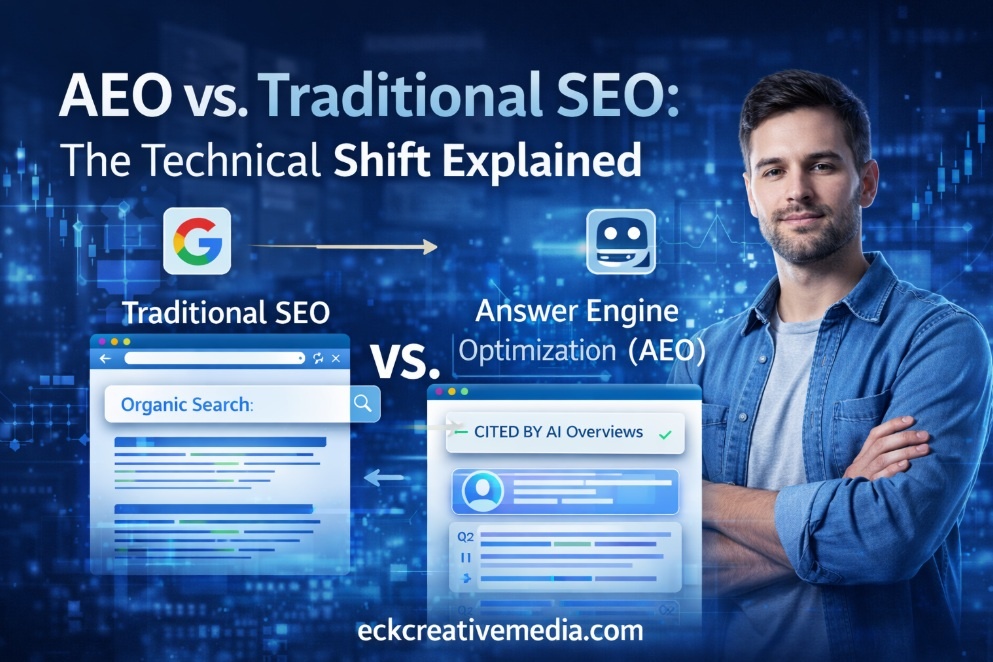
The way people discover businesses online has changed — quietly, but profoundly.
For years, digital visibility depended on one primary goal: ranking high on Google and earning the click. Today, discovery increasingly happens before a click ever occurs. AI-powered systems now summarize, synthesize, and recommend answers directly on the search results page.
We’ve entered what many call the Post-Search Era — an era defined by Answer Engine Optimization (AEO).
For small businesses, this shift is not a threat.
It’s an opportunity — when approached strategically.

The Evolution of Discovery: From Search to Answers
Search engines were once navigational tools. They pointed users toward information.
Today, they behave more like decision assistants.
AI-driven platforms now ask a different question:
“Which source provides the clearest, most reliable answer?”
Google’s AI Overviews, conversational assistants like ChatGPT, and answer engines such as Perplexity increasingly compress the traditional customer journey. Research, validation, and comparison often happen inside the answer itself.
If your content is not structured to be selected and cited by these systems, your brand can quietly lose visibility — even if your traditional SEO fundamentals remain strong.

Understanding Answer Engine Optimization (AEO)
Answer Engine Optimization (AEO) is the discipline of structuring your content so AI systems can easily understand it, trust it, and confidently use it as source material for answers.
In simple terms:
AEO helps your business become the answer, not just a link.
Traditional SEO focuses on:
- Rankings
- Clicks
- Traffic volume
AEO focuses on:
- Citations
- Brand mentions
- Trust signals
- Visibility before the click
This distinction defines modern discovery.
Why the Zero-Click Reality Demands a New Strategy
The rise of zero-click searches has unsettled many small business owners — and understandably so.
Zero-click does not mean zero opportunity.
It means the influence point has moved earlier.
When AI systems deliver answers directly on the search page, the businesses cited have shaped perception, credibility, and preference before a website visit ever occurs.
If your brand is included, you gain authority.
If it’s excluded, competitors define the narrative for you.
AEO exists to ensure your expertise appears at this earliest, most influential moment.
| Metric | Traditional SEO | Answer Engine Optimization (AEO) |
|---|---|---|
| Primary Goal | Rank high to earn clicks | Earn citations in AI answers |
| Success Signal | Traffic & rankings | Brand mentions & trust |
| Content Structure | Keyword-optimized narrative | Answer-first, structured, verifiable |
| Search Behavior | Short keyword queries | Conversational, intent-rich questions |
| Authority Signal | Backlinks & domain authority | Entity consistency, E-E-A-T, consensus |
AEO vs. Traditional SEO: The Technical Shift Explained
Core Pillars of a Modern AEO Strategy
Successful Answer Engine Optimization rests on three interconnected pillars:
1. Content Structuring for AI Parsing
AI models prioritize content that is clear, structured, and verifiable. Answer-first formatting, clean headings, lists, and schema markup dramatically increase selection probability.
2. Authority and Citation Readiness
AI systems rely on consensus. Brands consistently referenced across trusted sources earn citation preference, shaping perception before engagement begins.
3. Optimization for Conversational Intent
Search behavior is becoming more natural, nuanced, and goal-driven. Content must address micro-intents, not just keywords, compressing the journey from question to confidence.
These pillars establish trust — but trust alone does not guarantee recall.
Why AEO Alone Is Not Enough
AEO determines what AI says about your business.
But AI answers are:
- Informational
- Neutral
- Non-local
- Non-persistent
They explain — but they don’t remind.
Many businesses earn visibility in AI answers yet struggle to stay top-of-mind afterward. Visibility without memory is fragile.
This is where the next layer becomes essential.
IP Targeting: The Recall Layer in the Post-Search Era
IP targeting solves the one problem AI search cannot: consistent local presence.
- IP targeting allows your business to:
- Appear repeatedly within the same households
- Build familiarity over time
- Stay visible even when no search is happening
- Reach audiences without relying on cookies
In a compressed customer journey, repetition builds trust.
If AEO helps AI explain your business,
IP targeting helps customers remember it.
How AEO, Google Ads, and IP Targeting Work Together
These strategies operate at different moments—and that is precisely why they are powerful together.
- AEO influences understanding
- Google Ads captures high-intent action
- IP targeting reinforces recall and familiarity
This creates a complete visibility system.
A potential customer may:
-
Learn from an AI-generated answer
-
Later see your brand repeatedly online
-
Finally search, click, or convert
By the time action occurs, your business feels familiar, credible, and safe.
Why This Model Favors Small Businesses
Large brands rely on scale.
Small businesses win through precision and relevance.
- IP targeting allows small businesses to:
- Focus only on their service area
- Avoid wasted impressions
- Reinforce local trust
- Stay visible without massive budgets
This isn’t about chasing clicks.
It’s about owning your local visibility footprint.
Visibility Model
Layer 1 – Answer Content (AEO)
Build trust by becoming the source AI relies on.
Layer 2 – Intent Content (Google Ads)
Capture demand when readiness peaks.
Layer 3 – Recall Content (IP Targeting)
Stay present, familiar, and remembered.
This is not theory.
It’s how modern visibility works.
The Bottom Line
AI is not replacing trust.
It’s redefining where trust begins.
- Small businesses that win in the post-search era:
- Teach before they sell
- Show up before they’re needed
Stay visible even when no one is searching
AEO earns trust.
Ads capture intent.
IP targeting builds memory.
5 Surprising Facts about the Post-Search Era and Answer Engine Optimization (AEO)
-
- Voice and conversational queries now drive a large share of local intent: Many consumers ask devices for immediate, actionable answers like “best vegan cafe near me”—small businesses that optimize for direct answers can capture these ready-to-act customers.
- Search result pages often don’t send traffic: rich answers, knowledge panels, and zero-click results mean users get what they need without visiting a site, so being the source of that answer can be more valuable than clicks.
- Structured data and concise copy beat long-form SEO for featured answers: Proper schema markup and short, precise responses make businesses far more likely to be surfaced by answer engines than simply having lengthy content.
- Smaller sites can outrank giants for answer snippets: relevance, freshness, and clarity of the answer matter more than domain authority for many featured results, giving nimble local businesses a real chance to lead.
- Multimodal signals matter: voice, images, maps, and reviews feed into answer engines—optimizing business listings, images, and Q&A-style content multiplies the chances of being chosen as the canonical answer.
14 Common Mistakes People Make About the Post-Search Era and Answer Engine Optimization (AEO)
-
- Thinking AEO is just another name for SEO — AEO focuses on direct answers, conversational queries, and structured data rather than only backlinks and traditional ranking signals.
- Ignoring user intent and conversational queries — Treating queries like keywords instead of natural-language questions leads to poor alignment with answer engines and voice assistants.
- Relying solely on keyword-stuffed pages — Over-optimization for keywords won’t capture featured snippets, rich results, or voice responses that prefer concise, authoritative answers.
- Neglecting structured data and schema markup — Failing to implement schema limits an answer engine’s ability to extract and present your content as an immediate answer.
- Providing long-form content without clear, scannable answers — Answer engines favor short, direct responses (defined steps, Q&A blocks, and lists) that satisfy queries quickly.
- Not optimizing for conversational and voice search formats — Ignoring question formats, natural phrasing, and audio-friendly content reduces visibility in voice-driven answers.
- Assuming AEO is a one-time task — Answer optimization requires ongoing updates, testing, and monitoring as queries and answer engine behaviors evolve.
- Overlooking local context — For small businesses, failing to optimize for local, contextual queries (local schema, Google Business Profile, location-specific Q&A) misses high-value opportunities.
- Prioritizing quantity over trust and authority — Answer engines prioritize reliable, well-sourced content; thin or unverified answers get ignored or penalized.
- Failing to measure the right metrics — Focusing only on overall traffic instead of answer impressions, voice-answer clicks, snippet performance, and conversion from answer placements obscures AEO effectiveness.
- Not structuring content for multi-format reuse — Content that cannot be repurposed into short answer blocks, FAQs, and knowledge cards limits distribution to answer surfaces.
- Ignoring mobile and page speed — Slow, non-mobile-friendly pages reduce the chances of being chosen as an answer source for on-the-go or voice queries.
- Assuming privacy or personalization won’t affect answers — Ignoring how personalization and privacy settings shape which answers users see can lead to wrong optimization assumptions.
- Not collaborating across teams — Isolated SEO, content, product, and customer-service teams miss opportunities to surface real user questions and craft authoritative answers.
FAQ
How can small business marketing adapt to the post-search era?
Small business marketing must shift from traditional search rankings to AI-powered strategies by embracing answer engine optimization (AEO). This means creating AI-friendly content that anticipates direct answers, supports hyperlocal and household-level targeting, and works alongside existing SEO strategy. Use ai tools and ai engines to analyze queries, test SEO content, and measure impact on awareness and conversions so your marketing becomes future-proof rather than relying solely on traditional search results.
What does it mean to optimize content for ai search and voice queries?
To optimize for ai search, craft concise, structured content that answers specific user intents—think FAQs, schema-like patterns, and clear short answers that ai-powered search can surface. AEO focuses on becoming the succinct, authoritative response found in ai engines and search tools. Unlike traditional seo, aeo creates assets that appear in ai tools and supports search and buy moments by providing direct solutions rather than only driving clicks to a blog or landing page.
How will the future of local SEO and hyperlocal advertising change with AEO?
The future favors hyperlocal relevance: AI engines will prioritize localized, IP-based, and household-level signals to serve practical answers. Small businesses should build location-specific content, claim local profiles, and create critical SEO assets describing services, hours, and availability. This approach adds support for discovery in people search and local AI overviews, ensuring your business remains discoverable in cookieless, privacy-focused environments.
Can SEO success replace traditional search rankings and paid advertising?
AEO isn’t a complete replacement for traditional search rankings or paid ads, but it shifts the balance. AEO adds direct visibility in AI-powered search results, reducing reliance on clicks and sometimes decreasing paid spend for awareness. However, you still need strong SEO and complementary advertising strategies to drive brand depth and fallback traffic. Combining SEO to AEO tactics provides a robust framework for sustainable visibility.
What practical framework should small businesses use to move from SEO to AEO?
Adopt a practical framework: audit existing SEO content, identify high-intent queries, create AI-focused short-answer assets, and measure performance in AI tools. Integrate AI-friendly metadata, structured Q&A sections, and concise summaries that AI engines can parse. This SEO and AEO blend—treating AEO as the natural evolution of SEO—helps secure both traditional search results and appearances in Google AI overviews and other AI-powered interfaces.
Which tools and AI-powered solutions can support my AEO efforts?
Use search tools and AI tools to discover queries, simulate AI engine responses, and optimize for answer snippets. Platforms that analyze conversational queries, tools like query intent analyzers, and AI-powered content assistants help scale AEO content. Using AI tools also helps you prioritize assets that drive the most impact and supports testing whether content appears in AI tools or traditional search results.
How does AEO change the role of brand and content strategy?
AEO emphasizes brand clarity and trust: concise, authoritative answers build awareness and credibility directly in AI-powered search interfaces. Content strategy should include short-form answer assets, supportive long-form blog resources, and consistent brand signals so AI engines can attribute reliability. AEO creates micro-moments of brand connection that complement broader storytelling and advertising efforts.
What are common challenges when implementing AI search optimization for small businesses?
Challenges include understanding AI engines’ evolving criteria, balancing depth with brevity, and ensuring AI-friendly content without losing brand voice. AEO requires ongoing testing and monitoring because content that ranks in traditional search may not surface in AI-powered responses. Small businesses should expect to iterate, use AI tools for insights, and maintain core SEO practices to support both traditional search rankings and AEO efforts.
How can small businesses measure AEO impact and ensure long-term results?
Measure AEO impact by tracking visibility in AI overviews, changes in direct queries, conversion rates from AI-driven leads, and shifts in organic traffic patterns. Combine analytics from search tools, AI engines, and traditional metrics to form a holistic view. Focus on metrics that show awareness and search and buy behavior rather than only clicks—this future-proof approach ensures your AEO efforts translate into sustainable business results.
- Is AI Recommending Your Business? How to Measure AI Visibility - July 17, 2026
- The Ultimate Guide to Social Media Marketing: Success Strategies - July 9, 2026
- Landing Page Best Practices for Maximum Conversions - July 3, 2026


