 Skip to content
Ensuring Your Content Is Crawlable, Indexable, and Eligible for AI Citation
Before any generative AI system can cite or summarize your content, it must first be able to access, understand, and trust it.
Google’s AI Mode and AI Overviews rely on the same technical infrastructure as traditional search. If your pages cannot be reliably crawled, indexed, and rendered, they are effectively invisible—no matter how strong the content may be.
This guide outlines the non-negotiable technical requirements that must be met for content to be eligible for AI-driven search experiences.
Why Technical Accessibility Comes First
AI-driven search does not bypass technical SEO. In fact, it reinforces it.
Generative systems such as Google’s AI Mode draw from indexed content that meets strict quality and accessibility thresholds. If those thresholds are not met, the content cannot be selected, cited, or summarized.
Technical accessibility is the gatekeeper to visibility in answer-based search.
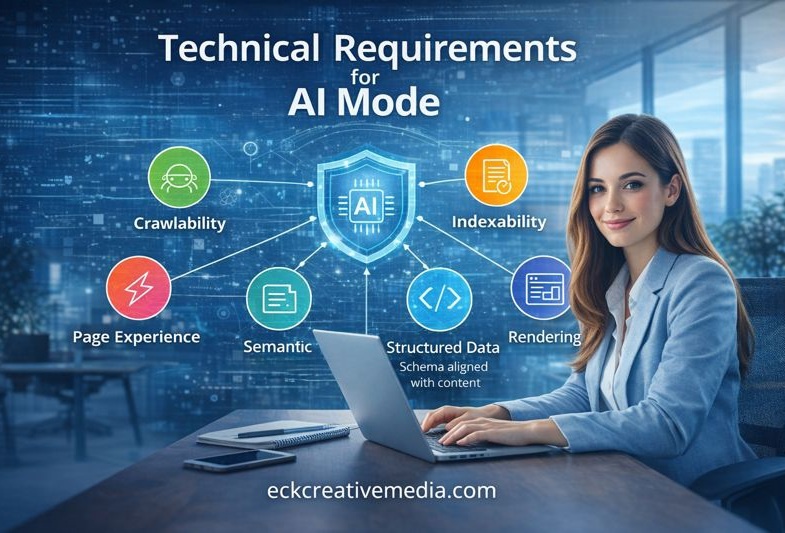
1. Crawlability: Ensuring Googlebot Can Access Your Content
If Googlebot cannot crawl a page, AI systems cannot use it.
Key crawlability requirements include:
-
robots.txt must allow Googlebot access to all critical content
-
Pages must not be blocked by
noindexor restrictive meta directives -
JavaScript-rendered content must be accessible and renderable
-
Important resources (CSS, JS, images) must not be blocked
AI Mode relies on the same crawl pipeline as traditional search. Blocking access at this level prevents inclusion entirely.
2. Indexability: Making Content Eligible for AI Use
Crawlability alone is not enough. Content must also be indexable.
Critical indexability checks:
-
Pages must return a valid HTTP 200 (success) status code
-
Canonical tags must correctly identify the preferred URL
-
Duplicate or conflicting URLs must be resolved
-
Content must be visible in the rendered DOM
AI systems only draw from content that has successfully entered Google’s index. Pages excluded from indexing cannot be surfaced in AI experiences.
3. Page Experience and Performance Signals
AI systems increasingly favor content that delivers a strong page experience.
Important factors include:
-
Fast load times and low latency of experience
-
Stable layouts with minimal visual shift
-
Mobile-friendly rendering
-
Secure delivery (HTTPS)
While performance alone does not guarantee AI visibility, poor experience signals reduce the likelihood of selection when multiple sources cover the same topic.
4. Structured Data and Technical Clarity
Structured data does not guarantee inclusion in AI Overviews or AI Mode—but it significantly improves contextual understanding.
Technical best practices include:
-
Valid JSON-LD markup aligned with visible content
-
Accurate entity relationships (Organization, Article, FAQPage, etc.)
-
No misleading or unsupported schema claims
-
Regular validation using Google’s Rich Results Test
Structured data helps AI systems interpret what the content represents, not just what it says.
5. Preview Controls and Visibility Management
Site owners retain control over how content is surfaced in AI-driven search.
Preview controls include:
-
nosnippet– prevents snippets and AI summaries -
max-snippet– limits the length of excerpts -
data-nosnippet– excludes specific sections of content
Restricting snippets often restricts AI visibility as well. These controls should be used carefully and intentionally.
6. Rendering and Content Visibility
AI systems evaluate rendered content, not just source code.
Ensure that:
-
Primary content is visible without user interaction
-
Important text is not hidden behind tabs or scripts
-
Lazy-loaded elements are accessible to Googlebot
-
Server-side or hybrid rendering is used where appropriate
If content is not visible to Google’s rendering systems, it cannot be used by AI.
Technical Accessibility Is the Foundation of AEO
Answer Engine Optimization depends on trust, clarity, and accessibility.
No amount of content depth, expertise, or originality can compensate for technical barriers that prevent AI systems from accessing your work.
Meeting these technical requirements ensures your content is eligible—the first and most critical step toward being cited in AI Mode and AI Overviews.
Frequently Asked Questions
What technical requirements must be met for AI Mode visibility?
Content must be crawlable, indexable, renderable, and accessible to Googlebot. Pages must return HTTP 200 status codes and avoid blocking directives.
Does AI Mode use the same crawl and index systems as Google Search?
Yes. AI Mode relies on the same crawling, indexing, and rendering infrastructure as traditional Google Search.
Is structured data required for AI visibility?
Structured data is not required, but it significantly improves clarity and eligibility by helping AI systems understand context and entities.
Can performance issues affect AI citations?
Yes. Poor page experience and slow load times reduce the likelihood that content will be selected when competing sources exist.
Do preview controls affect AI Overviews?
Yes. Using nosnippet or restrictive preview controls often prevents content from being used in AI summaries.