 Skip to content
How Schema and Semantic Markup Help AI Systems Understand, Trust, and Cite Your Content
As search becomes increasingly answer-driven, understanding context matters as much as content itself.
Google’s AI Mode and AI Overviews do not simply extract text. They evaluate entities, relationships, and factual structure to determine whether content can be trusted, synthesized, and cited.
This is where structured data plays a critical role.
Why Structured Data Matters for AI-Driven Search
Structured data provides machine-readable context that helps AI systems interpret what your content represents—not just what it says.
While structured data does not guarantee inclusion in AI Overviews or AI Mode, it significantly improves:
-
Semantic clarity
-
Entity recognition
-
Eligibility for rich results
-
Confidence during AI synthesis
In answer-based search, clarity accelerates trust.
Structured Data vs. Traditional Content Signals
Traditional SEO signals help search engines rank pages.
Structured data helps AI systems understand meaning.
| Without Structured Data | With Structured Data |
|---|---|
| Text must be inferred | Meaning is explicit |
| Context is ambiguous | Entities are defined |
| Relationships are assumed | Relationships are stated |
| Higher interpretation risk | Lower interpretation risk |
Key Schema Types That Support AI Citations
Not all schema types are equally valuable for AI-driven search. Focus on schema that clarifies who, what, and why.
Core Schema Types
-
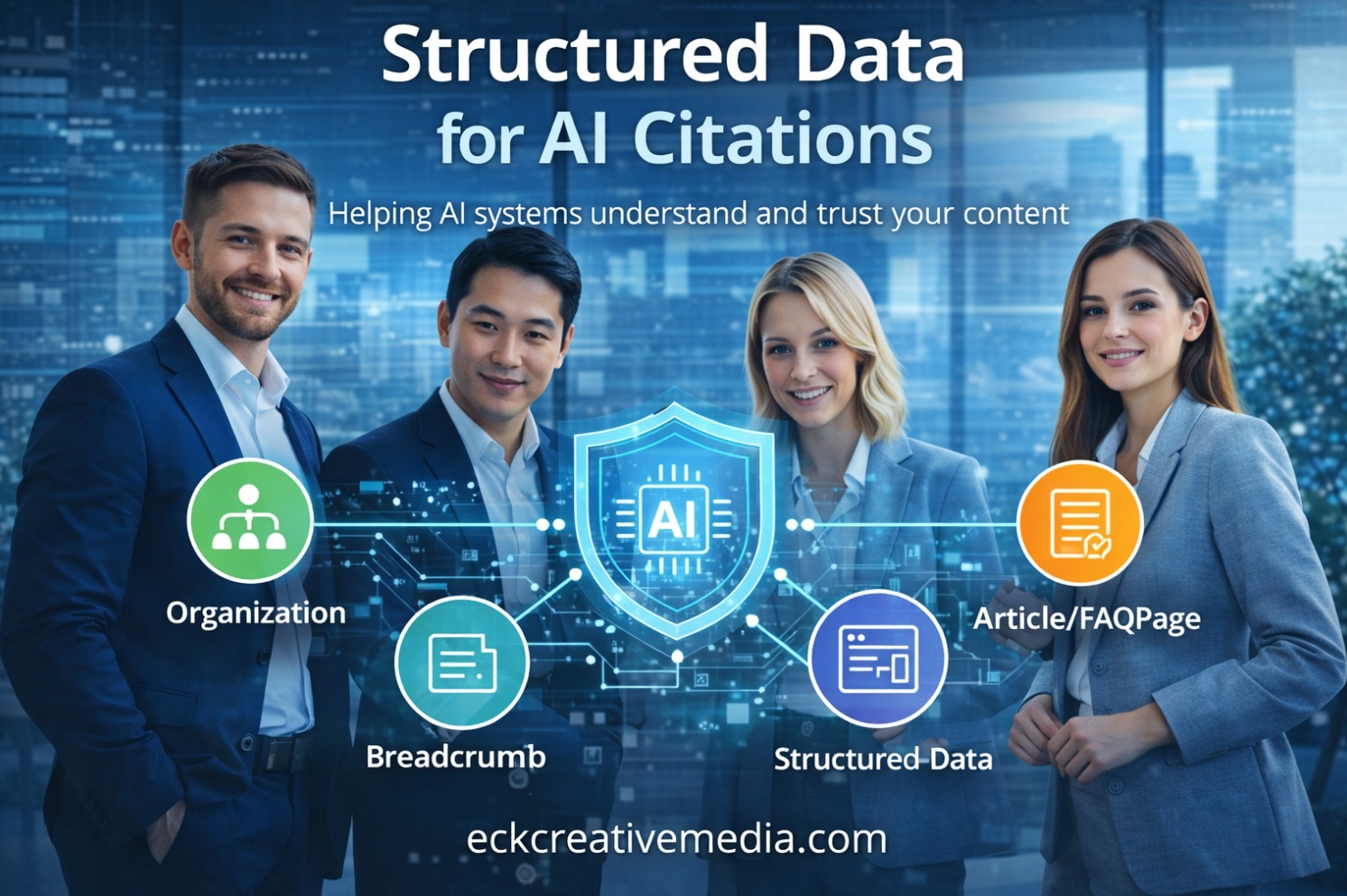
Organization / LocalBusiness – establishes entity trust
-
Article / BlogPosting – defines editorial content
-
FAQPage – provides direct answer structures
-
BreadcrumbList – reinforces hierarchy and context
These schemas form the semantic backbone of AI-eligible content.
Entity Clarity and Semantic Alignment
AI systems operate on entities, not keywords.
Structured data helps define:
-
Who created the content
-
What topic it addresses
-
How concepts relate to each other
-
Which entity owns or stands behind the information
This clarity allows AI systems to confidently associate facts with your brand, increasing citation likelihood.
Alignment Between Schema and Visible Content
One of the most common mistakes is schema misalignment.
Best practices:
-
Schema must reflect visible, user-facing content
-
Do not mark up information that does not appear on the page
-
Avoid exaggerated or unsupported claims
-
Ensure consistency across titles, headings, and schema fields
AI systems cross-check structured data against rendered content. Misalignment reduces trust.
SON-LD and Technical Implementation
Google recommends JSON-LD as the preferred structured data format.
Implementation guidelines:
-
Place JSON-LD in the
<head>or body -
Keep markup clean and readable
-
Avoid duplicate or conflicting schema blocks
-
Validate after every update
Well-implemented structured data acts as a semantic map for AI systems.
Validation Is Non-Negotiable
Structured data only helps if it is valid.
Validation steps include:
-
Use Google’s Rich Results Test
-
Check for errors and warnings
-
Confirm schema matches visible content
-
Revalidate after content updates
Invalid schema introduces uncertainty—something AI systems avoid.
Structured Data and AI Mode Eligibility
AI Mode draws from content that is:
-
Indexed
-
Trusted
-
Semantically clear
Structured data helps AI systems:
-
Identify authoritative sources
-
Extract factual components
-
Attribute information correctly
-
Reduce hallucination risk
In short, structured data improves citation confidence.
Common Structured Data Mistakes to Avoid
-
Marking up sales pages as articles
-
Using FAQ schema on non-FAQ content
-
Duplicating schema across unrelated pages
-
Adding schema “just because”
Structured data should clarify reality, not decorate pages.
Structured Data Is an AEO Multiplier
Answer Engine Optimization depends on clarity.
Structured data does not replace good content—but it amplifies it by making meaning explicit for AI systems.
When combined with technical accessibility and people-first content, structured data becomes a powerful signal for AI citation eligibility.
Frequently Asked Questions
Does structured data guarantee AI citations?
No. Structured data improves clarity and eligibility but does not guarantee inclusion in AI Overviews or AI Mode.
Which schema types are most important for AI search?
Organization, Article, FAQPage, and Breadcrumb schema provide the strongest semantic foundation.
Can incorrect schema hurt AI visibility?
Yes. Misaligned or invalid schema reduces trust and may exclude content from AI-driven experiences.
Should every page use structured data?
Only where it accurately represents the content. Overuse or misuse creates confusion.
How often should structured data be validated?
After every significant content update or structural change.