Skip to content
For more than two decades, digital marketing followed a familiar rhythm:
People searched, websites competed, and clicks decided winners.
That era is ending.
As we close out 2025, data now confirms what many marketers have quietly felt for months: conversational AI has overtaken traditional search as a primary discovery channel in key verticals. Consumers increasingly ask AI assistants what to buy, who to trust, and where to go — and they act directly on the answers they receive.
This shift isn’t incremental. It’s structural.
This shift alters the locations where visibility occurs.

From Search Engines to Answer Engines
In the emerging “post-search” environment, ranking first on a search results page matters far less than being cited by AI systems when answers are generated.
This evolution is often described as the move from SEO (Search Engine Optimization) to AEO (Answer Engine Optimization)—structuring content so AI can easily extract, trust, and recommend it.
AEO is essential.
But it is not sufficient.
Why?
This is because AI-generated answers increasingly eliminate the need for users to click on links.
When a consumer trusts the answer, they don’t browse ten websites. They don’t comparison-shop the old way. The decision is often made before a website visit ever occurs.
Which raises a critical question for 2026:
If AI gives the answer, how does your brand remain visible after the answer is delivered?
AEO Solves Authority — Not Reach
Answer Engine Optimization helps brands:
- Be cited
- Be trusted
- Be recommended
What it does not guarantee is sustained exposure.
Being the answer doesn’t mean being remembered.
Once the AI response is delivered, the consumer continues living their life — scrolling, watching TV, browsing news, checking email. This is where most marketing strategies quietly lose momentum.
And this is precisely where IP targeting becomes the missing layer.
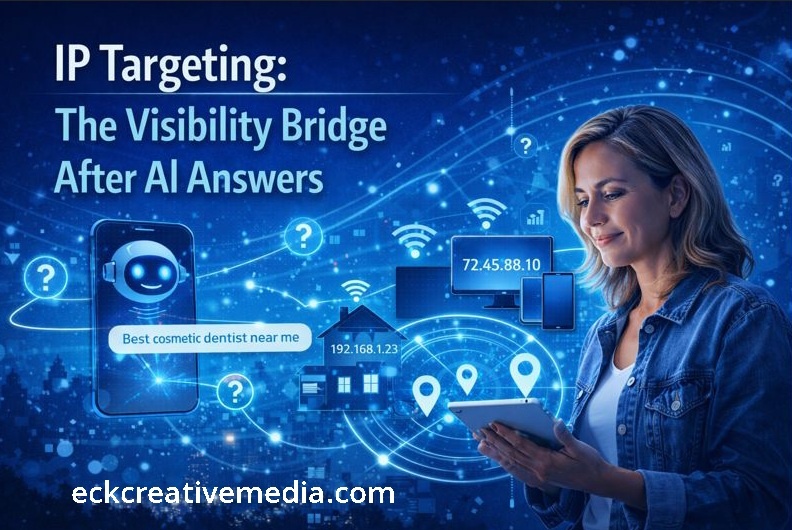
IP Targeting: The Visibility Bridge After AI Answers
IP targeting operates at a fundamentally different level than search or keywords.
Instead of waiting for someone to search again, IP targeting allows brands to:
- Reach households and devices directly
- Reinforce awareness across screens (display, mobile, CTV)
- Maintain presence after intent is already established
In a post-search world, the flow looks like this:
AI creates intent; → IP targeting sustains presence; → repetition builds trust; → action follows.
This is not about chasing traffic.
It’s about controlling visibility continuity.

Why This Matters Most for Local and Regulated Businesses
This shift disproportionately impacts industries where trust, timing, and local relevance matter most:
- Healthcare & dental practices
- Home services (plumbing, HVAC, electrical)
- Professional services
- Education & specialty retail
These businesses don’t need more traffic.
They need fewer, better decisions.
IP targeting allows messaging to stay in front of the exact households most likely to convert — even when search behavior disappears.
The 2026 Marketing Stack: A New Mental Model
Winning strategies in 2026 are not about replacing SEO or Google Ads.
They’re about layering intelligently.
A simple framework:
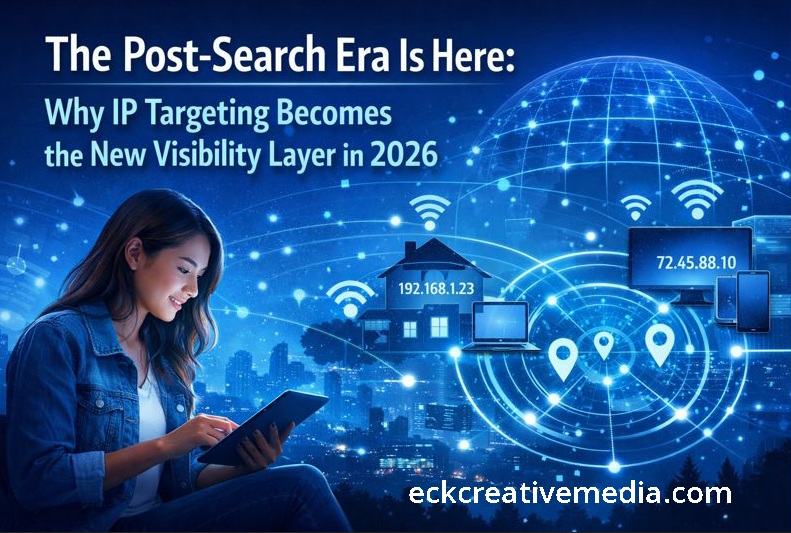
AEO (Answer Engine Optimization) establishes trust by matching content, user experience, and engagement signals, making organizations seen as trustworthy by both people and machines, which helps clarify why IP targeting will be the new way to gain visibility in 2026: IP targeting provides visibility. As networks and devices pay more attention to how users behave and the context they’re in, effective AEO practices ensure that the right audiences get the right messages through IP-based routing, local delivery, and trusted distribution, meaning visibility relies on established authority at every interaction.
IP targeting helps marketers see how well their ads are doing by connecting information from devices and homes to specific audience groups, which allows them to monitor where ads are shown and how users engage with them on different screens; this is why IP targeting will become the main way to measure ad performance in 2026 as the industry moves away from cookies to more dependable, network-based identifiers. By using data collected directly from users, reliable matching rates, and strong data protection, IP targeting offers clear ways to measure success, better visibility, and tracking across different devices without depending on third-party cookies, making it a smart choice for protecting brands, managing ad frequency, and improving marketing campaigns. As publishers and platforms standardize consented IP-based methods and analytics tools add real-time reporting, advertisers gain the granular diagnostics and unified dashboards needed to verify delivery, reduce waste, and confidently link spending to outcomes, which is why ip targeting becomes the new visibility layer in 2026.
Connected TV, display advertising, and location targeting work together to improve memory by using the wide reach of connected TV, the accuracy of display ads, and the strong impact of targeting specific areas. This is why IP targeting will be the new way to gain visibility in 2026: by linking device IPs to locations and audience groups, marketers can manage how often ads are shown and what content is displayed on different channels to boost brand recall, cut down on wasted views, and ensure consistent messages at important times, which aids in tracking, measuring, and the overall success of campaigns across various channels.
Together, they form a closed loop — one that doesn’t depend on clicks to function.
5 Surprising Facts About Why IP Targeting Will Become the New Visibility Layer in 2026
- Cookie deprecation accelerated adoption: With third-party cookies largely phased out and regulations tightening, advertisers rapidly turned to IP-level targeting as a deterministic, cross-device fallback — adoption rose far faster than most forecasts.
- Network graphs unlocked precise audience maps: Advances in graph analytics and large-scale network stitching made it possible to map household and business clusters via IP relationships, enabling visibility across devices and locations without relying on individual identifiers.
- Real-time edge processing made scaling feasible: Widespread deployment of edge compute in 2024–2025 allowed IP-based decisions to happen at low latency and high volume, making IP targeting practical for programmatic buying and instant personalization.
- Privacy technology was reframed to enable its use rather than block it: New privacy-preserving techniques (aggregation thresholds, differential privacy, and on-device matching) let marketers use IP-derived cohorts while meeting regulatory and consumer-privacy requirements, shifting perception from risky to compliant.
- Context and identity fusion boosted measurement accuracy: Mixing IP-derived visibility with contextual signals (like page content, time, and location) greatly enhanced how well we could track and model conversions, uncovering benefits that simpler methods overlooked and establishing IP targeting as the new way to see audience behavior.
15 Common Mistakes People Make About Why IP Targeting Becomes the New Visibility Layer in 2026
This list highlights frequent errors organizations and practitioners make when approaching why IP targeting becomes the new visibility layer in 2026, with concise explanations to help avoid them.
- Assuming IP targeting is a silver bullet for attribution — Treating IP targeting as a standalone fix ignores the need to combine it with contextual signals, consent management, and measurement frameworks to get accurate attribution and reliable insights.
- Overlooking privacy and compliance nuances — Believing IP targeting is automatically privacy-safe can lead to violations. By 2026, evolving regulations (GDPR, ePrivacy, CCPA-style laws) and local rules require explicit checks, proper anonymization, and documented lawful basis.
- Mistaking IP matching for perfect identity — Assuming IP-to-user mapping is 1:1 is incorrect. Shared networks, VPNs, mobile carrier NAT, and dynamic IPs introduce noise; IP targeting is a signal, not a definitive identifier.
- Ignoring device and network changes — Failing to account for IPv6 adoption, mobile carrier routing, and increased use of encrypted DNS and proxies will reduce accuracy if models aren’t continuously updated.
- Neglecting signal decay and timeliness — Treating IP mappings as durable facts leads to stale targeting. IP-based visibility requires frequent refreshes and real-time processing to remain effective.
- Underestimating cross-domain and cross-device linking challenges — Relying solely on IP targeting for cross-device measurement misses scenarios where users switch networks or use separate devices with different network characteristics.
- Failing to validate vendor claims — Accepting vendor accuracy numbers without independent testing or audit can result in overpaying or poor campaign performance. Insist on transparency, validation datasets, and SLAs.
- Not planning for adversarial and security risks — Ignoring spoofing, bot traffic, and deliberate obfuscation of IP signals can corrupt visibility layers. Implement fraud detection and anomaly monitoring.
- Applying IP targeting uniformly across all use cases — Treating every campaign or analytic need the same overlooks use-case differences. Some scenarios (B2B geographic reach, store-level attribution) benefit more from IP-based visibility than others (individual-level personalization).
- Overcomplicating implementation without clear KPIs — Rolling out IP targeting without defined success metrics, baseline measurements, or integration plans leads to disappointing ROI and fractured analytics.
- Ignoring ethical considerations and user expectations — Focusing solely on technical gains while neglecting transparency, choice, and user trust can damage brand reputation and long-term effectiveness.
- Relying on legacy infrastructure — Using outdated data pipelines or batch-only systems won’t support the near-real-time, high-volume demands of IP-based visibility expected in 2026.
- Failing to integrate with broader measurement ecosystems — Treating IP targeting as isolated prevents it from enhancing walled-garden data, server-side measurement, and privacy-preserving attribution methods.
- Under-investing in talent and governance — Skimping on data engineering, legal review, and governance processes undermines the quality and compliance of an IP-based visibility layer.
- Neglecting user experience impact — Aggressive or poorly targeted experiences driven by IP signals can create irrelevant ads or throttled content experiences, reducing engagement and trust.
Organizations can effectively use IP targeting in 2026 by treating IP signals as part of a balanced, privacy-focused strategy that includes regular checks, governance, and clear business goals.
FAQ
Trend: Why IP targeting becomes the new visibility layer in 2026 — a prediction for the future
IP targeting rises as the new visibility layer because the industry moves beyond third-party cookies and embraces cookieless, geo-aware approaches that preserve measurement and frequency control. In 2026 this trend will be defined by a full shift toward first-party data orchestration, programmatic integrations, and ai-driven models that infer intent and map consumer behaviors across devices while addressing privacy and cybersecurity concerns.
Brand strategy: How will IP targeting influence brand advertising and programmatic buying?
Brands will adopt IP targeting to maintain deterministic reach and reduce dependency on legacy identifiers. Programmatic stacks will integrate IP-based segments with CTV and TV delivery, allowing brands to target households and multi-screen funnels more accurately. This approach complements first-party data, enables cross-device cohesion, and becomes essential for organizations that want to sustain performance in a post-cookieless ecosystem.
First-party data: Can IP targeting replace full first-party data strategies?
IP targeting is not a replacement but a powerful augmentation of first-party data. It helps bridge gaps when cookieless identifiers decline and supports audience expansion and lookalike modeling. Combined with generative ai and ai-driven analytics, IP signals enrich consumer intent profiles while preserving privacy, helping organizations adapt to 2026 requirements and maintain measurement continuity.
Advertising and TV: Will IP targeting reshape CTV and broadcast TV advertising?
Yes. IP targeting naturally maps to household-level CTV and addressable TV, improving attribution and frequency control across linear and programmatic TV buys. In 2026, advertisers will see reduced fragmentation between digital and TV, using IP-based supply chain integrations to steer campaigns and measure impact across screens, with tools like cross-platform dashboards and ai models for audience matching.
Data and intent: How accurate is intent inference from IP-level signals?
IP-level intent inference can work really well when it’s used alongside context, behavior, and data from the company itself Ai tools and new AI models help reconstruct intent patterns while smoothing noise. While not as granular as user-level identifiers, IP plus device and household data offers a robust prediction layer that supports targeting, measurement, and privacy-preserving personalization in 2026.
Consumer trust and cybersecurity: What about privacy and cyber threat concerns with IP targeting?
Privacy and cybersecurity are central to IP targeting adoption. Organizations must implement rigorous anonymization, geo-based aggregation, and consent management to mitigate cyber threat and compliance risks. Cybersecurity predictions for 2026 expect stricter controls and standards; combining IP strategies with strong governance and encryption reduces exposure and helps regulators accept alternative, privacy-first approaches.
Programmatic and beyond: How will programmatic ecosystems change with IP as a visibility layer?
Programmatic platforms will instrument IP as a core identifier for supply path optimization, fraud reduction, and cross-domain measurement. This change will bring supply chain transparency and a reduction in wasted spending, while programmatic buyers use AI-driven optimization and reinforcement learning to allocate budgets across channels. Predictions for 2026 include wider adoption of standardized IP signal APIs and cross-party match frameworks.
AI-driven future: Will generative AI and AI models enable better use of IP targeting?
Absolutely. Generative AI and AI models will combine scattered information, make predictions about audiences, and automatically divide IP data into segments. Tools in 2026 will allow marketers to use generative AI to create contextual creativity and tailor messaging to household-level insights. The rise of agentic AI and its adoption in 2026 will mark a turning point where AI-driven orchestration becomes the backbone of IP-based visibility.
Beyond 2025: What are the practical steps brands should take ahead to 2026?
Brands should inventory first-party data, test IP-based targeting pilots across CTV and programmatic channels, and invest in AI tools and cybersecurity frameworks. Prepare supply chain partnerships for cross-device mapping, adopt privacy-first alternatives to cookies, and build internal capabilities to use generative AI and AI-driven measurement. These steps will help brands adapt to the new visibility layer and continue in 2026 with resilient, future-ready strategies.
- Is AI Recommending Your Business? How to Measure AI Visibility - July 17, 2026
- The Ultimate Guide to Social Media Marketing: Success Strategies - July 9, 2026
- Landing Page Best Practices for Maximum Conversions - July 3, 2026