Skip to content

IP targeting advertising allows businesses to deliver ads to specific households, buildings, or commercial locations using anonymized IP address data. When used strategically, it enables precise local visibility, pre-intent brand awareness, and multi-device reach—without relying on cookies or search behavior.
However, the effectiveness of IP targeting is not guaranteed. Its effectiveness depends on data quality, integration discipline, and realistic expectations about accuracy and privacy.
This guide explains how IP targeting actually works, where it succeeds, where teams go wrong, and how to use it as part of a modern, AI-ready marketing strategy.
Understanding the Technical Framework of IP Targeting
IP targeting works best for organizations that:
-
Serve defined geographic markets
-
Understand their customer segments
-
Value awareness before active search
It excels in local services, healthcare, home services, professional firms, and retail—where familiarity often precedes conversion.
The Core Limitation (Often Ignored)
IP targeting does not guarantee perfect location accuracy.
Roughly 20–30% of users access the internet through:
-
VPNs
-
Mobile carrier routing
-
Corporate proxies
This can shift apparent location and create false expectations if campaigns are built assuming pinpoint precision.
Peach truth:
IP targeting is about consistency, not perfection.
How IP Addresses Are Allocated (And Why It Matters)
IP addresses fall into two main categories:
Static IP Addresses
-
Fixed to a location or organization
-
Common in businesses and institutions
-
Ideal for consistent targeting
Dynamic IP Addresses
-
Change periodically
-
Common in residential and mobile environments
-
Require repetition rather than precision
Successful campaigns account for this by focusing on frequency and exposure over time, not single impressions.
How IP Targeting Technology Actually Works
IP targeting platforms rely on large, constantly updated databases that map IP ranges to:
-
Household types
-
Commercial zones
Accuracy depends entirely on:
-
Database freshness
-
Data provider quality
-
Cross-validation with other signals
Outdated IP data is one of the primary causes of wasted spend.

Data Enrichment: Where IP Targeting Becomes Powerful
IP targeting alone is blunt.
IP targeting with enrichment is strategic.
Companies that combine multiple data sources see ~20% higher engagement on average.
Common Enrichment Layers
-
-
Demographic overlays
-
Behavioral patterns
-
Business or household classification
-
CRM matching
Real-World Example
A regional home improvement retailer enriches IP targeting with purchase behavior data, allowing ads to speak differently to:
-
DIY homeowners
-
Eco-conscious buyers
-
Remodelers vs. maintenance customers
-
Warning:
Third-party data must be audited regularly. Stale data quietly destroys performance.
Integrating CRM Data (Without Overconfidence)
CRM integration allows businesses to:
-
Reinforce messaging to existing customers
-
Support upsells and renewals
-
Maintain local familiarity across devices
But CRM data is historical, not predictive.
Teams often assume CRM insight equals current intent.
It doesn’t.
Best practice:
-
Validate CRM segments against real-world response
-
Refresh data frequently
-
Treat CRM as context, not truth
IP Targeting and Geolocation: A Smart Combination
IP targeting works best when paired—not replaced—with geolocation signals.
When This Pairing Works Well
-
Brick-and-mortar businesses
-
Time-based promotions
-
Local service windows
Example:
A coffee chain promotes morning offers only to nearby households during commute hours.
Common Mistake
Using broad geolocation without accounting for:
-
Local culture
-
Seasonal behavior
-
Neighborhood differences
Local nuance matters more than radius size.
Crafting Messaging That Actually Resonates
IP targeting fails most often at the message level, not the technology.
The Persona Trap
Many teams create one “ideal customer” and reuse the same message everywhere.
Reality:
-
Households differ
-
Businesses differ
-
Motivations differ
Better Approach
Build lightweight personas informed by:
-
Location type (residential vs commercial)
-
Industry or lifestyle indicators
-
Time-of-day behavior
Dynamic Content & A/B Testing (Done Correctly)
Dynamic content allows ads to adapt based on:
-
Region
-
Weather
-
Season
-
Context
Example:
Winter apparel for northern regions, summer collections for southern ones.
A/B Testing Mistake
Testing without segmentation.
A/B tests must be run inside defined groups, or results become meaningless.
Compliance, Privacy, and Ethical Use
IP targeting exists within evolving privacy regulations, including GDPR and CCPA.
Key Compliance Principles
-
IP data must be anonymized
-
Users must be informed
-
Consent mechanisms must be clear
Companies that treat compliance as a trust strategy—not a legal checkbox—outperform long term.
Peach principle:
Privacy-respectful targeting builds brand equity, not just compliance.
IP Targeting in Multi-Channel Campaigns
IP targeting is most effective when synchronized with:
-
Google Ads
-
Email marketing
-
Display and video
-
Website personalization
Example:
A local fitness center combines:
-
IP-targeted display ads
-
Location-based emails
-
Landing pages aligned to the same message
The result is reinforcement, not noise.
Measuring What Actually Matters
Advanced analytics are essential—but dangerous when misused.
What to Track
-
Lift in branded search
-
Direct traffic growth
-
Conversion velocity
-
Geographic response patterns
What to Avoid
-
Chasing clicks alone
-
Over-reacting to short-term data
-
Treating volume as success
Unified analytics across channels typically improve performance by ~30%.
Machine Learning & Predictive Optimization
Machine learning can enhance IP targeting by:
-
Identifying behavioral patterns
-
Predicting timing and interest
-
Refining segments dynamically
But it requires:
-
Ongoing validation
-
Human oversight
-
Strategic interpretation
AI is an amplifier—not a substitute—for thinking.
Case Insights: What Works (and What Fails)
Successful Use
-
Hospitality brands filling weekday gaps
-
Gyms increase local memberships by 40%.
-
Financial services improving ROI by 250% through refinement
Failed Use
-
Broad targeting without segmentation
-
Static messaging during seasonal shifts
-
Overconfidence in automation
Lesson:
IP targeting rewards discipline, not shortcuts.
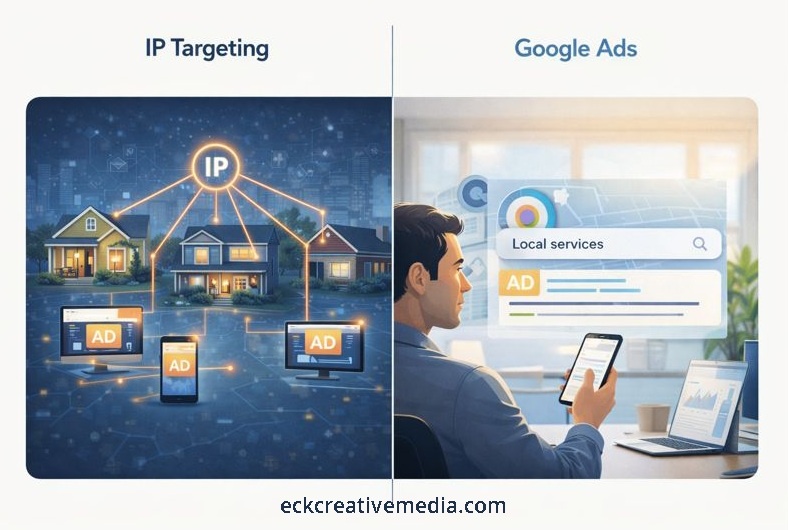
IP Targeting vs Google Ads: What’s the Difference?
IP Targeting Advertising
How it works:
Delivers ads to specific households, buildings, or business locations using anonymized IP address data.
Best for:
-
Local brand awareness
-
Pre-intent visibility
-
Long consideration cycles
-
Multi-device household reach
Strengths:
-
Cookie-free and privacy-forward
-
Builds familiarity before search
-
Reaches people at home and work
-
Supports AEO and AI discovery
Limitations:
-
Not designed for instant clicks
-
Requires strategic messaging and patience
Google Ads (Search Advertising)
How it works:
Shows ads to users actively searching for specific keywords.
Best for:
-
High-intent, time-sensitive needs
-
Emergency or immediate services
-
Clear keyword-driven demand
Strengths:
-
Captures demand at the moment it appears
-
Strong conversion potential
-
Easy to measure short-term ROI
Limitations:
-
Competitive and increasingly expensive
-
Stops working when spend stops
-
No visibility before intent exists
The Smart Strategy: Use Both Together
Google Ads captures existing demand.
IP targeting creates future demand.
When combined:
-
IP targeting builds trust and recognition
-
Google Ads converts when the search happens
-
AEO and AI tools surface familiar brands first
This layered approach creates a post-search visibility system, not a single-channel dependency.
The Future of IP Targeting Advertising
2026 and beyond:
-
Privacy regulation coverage will exceed 75% of global users
-
AI-driven personalization will increase
-
Trust will become a ranking signal
Brands that succeed will:
-
Combine IP targeting with AEO
-
Build familiarity before search
-
Prioritize transparency

5 Surprising Facts About IP Targeting Advertising Advanced Strategies to Reach Your Ideal Customers
- IP targeting can reach households, not just devices: By mapping IP ranges to physical addresses, advertisers can serve ads to entire homes or offices, improving message frequency without relying on cookies.
- It preserves privacy while enabling precision: modern IP targeting often aggregates and hashes identifiers, allowing hyper-targeted campaigns without exposing personal data or requiring third-party cookies.
- IP-based tactics can reduce wasted AD spend dramatically: Targeting known high-value locations (e.g., competitor sites, industry hubs) can lift conversion rates because ads focus on IPs associated with likely buyers instead of broad demographics.
- Cross-device attribution becomes more accurate: Advanced IP matching links devices on the same network (phone, tablet, laptop), helping attribute conversions across devices without intrusive tracking methods.
- Geofencing via IP can be faster and cheaper than GPS methods: For B2B and fixed-location audiences, IP geolocation offers reliable targeting at city- or building-level granularity without requiring mobile location permissions, lowering campaign friction and cost.
14 Common Mistakes People Make About IP Targeting Advertising Advanced Strategies to Reach Your Ideal Customers
- Confusing IP Targeting with Personal Identification: Assuming IP targeting identifies individuals rather than devices or networks; this leads to privacy and compliance errors.
- Overlooking Data Accuracy and Freshness: Using outdated or low-quality IP-to-location datasets causes mis-targeting and wasted ad spend.
- Ignoring GDPR and CCPA Constraints: Failing to account for regional privacy laws when using IP-based signals can result in legal risk and fines.
- Expecting Perfect Precision: Believing IP targeting offers pinpoint accuracy; it’s probabilistic and better suited for neighborhood, office, or ISP-level targeting than exact addresses.
- Neglecting Device and Network Complexity: Failing to account for VPNs, mobile carrier NAT, dynamic IPs, and shared IPs that distort location and audience signals.
- Poor Audience Segmentation: Targeting broad IP ranges instead of refined segments (e.g., enterprise vs. residential) reduces relevance and ROI.
- Not Combining Signals: Relying solely on IP targeting instead of layering with behavioral, contextual, and first-party data limits campaign effectiveness.
- Underestimating Frequency Capping Needs: Overexposure to the same IP range or household leads to ad fatigue and negative brand perception.
- Failing to Test and Measure: Skipping A/B tests, uplift studies, and proper attribution makes it impossible to evaluate whether IP targeting strategies actually reach ideal customers.
- Poor Creative and Messaging Alignment: Using generic creatives for IP-targeted segments rather than tailored messaging reduces engagement and conversion rates.
- Assuming One-Size-Fits-All Platforms: Not all ad platforms support advanced IP targeting features; assuming parity leads to implementation gaps and unmet expectations.
- Ignoring Fraud and Bot Traffic: Not filtering for malicious or non-human traffic can inflate reach metrics and waste budget.
- Overlooking Cost Efficiency: Overbidding for narrow IP segments without clear performance benchmarks can increase CPA and lower ROI.
- Skipping Privacy-Forward Alternatives: Neglecting to explore cohort-based or contextual replacements where IP targeting is restricted or ineffective.
FAQ
What is IP targeting advertising?
IP targeting advertising is a digital marketing method that delivers ads to specific households, buildings, or businesses using anonymized IP address data. It enables location-based reach across multiple devices without relying on cookies or search behavior.
How accurate is IP targeting?
IP targeting is directionally accurate rather than exact. While many IP addresses reliably map to geographic areas, factors such as VPNs, mobile networks, and dynamic IPs can affect precision. Effective campaigns focus on reach and frequency over time rather than single-impression accuracy.
Is IP targeting privacy compliant?
Yes. When implemented properly, IP targeting uses anonymized, non-personally identifiable data and does not identify individuals. It can comply with privacy regulations such as GDPR and CCPA when transparency and consent standards are followed.
What types of businesses benefit most from IP targeting?
IP targeting is especially effective for:
-
Local service businesses
-
Medical and dental practices
-
Home services
-
Retail and hospitality
-
Professional services
It works best where trust and familiarity influence decisions before a customer actively searches.
What is the difference between IP targeting and geotargeting?
Geotargeting delivers ads based on real-time location or search intent. IP targeting delivers ads to specific locations consistently across devices, even when users are not actively searching. Geotargeting reacts to intent; IP targeting builds awareness before intent appears.
Can IP targeting be combined with other marketing channels?
Yes. IP targeting performs best when integrated with Google Ads, email marketing, display advertising, and website personalization. This multi-channel alignment reinforces messaging and improves overall campaign performance.
How do you measure the success of IP targeting campaigns?
Success is measured using:
-
Branded search lift
-
Direct traffic growth
-
Conversion rates
-
Geographic engagement patterns
-
Return on investment (ROI)
Unified analytics across channels provide the clearest performance insight.
Does IP targeting work with AI-driven search and AEO?
Yes. IP targeting increases brand familiarity before a user searches or asks an AI assistant for recommendations. This pre-intent visibility improves the likelihood that AI systems surface and trust the brand later.
How does IP targeting work in B2B or account-based marketing?
In B2B marketing, IP targeting is used to reach specific companies by targeting known company IP ranges. This supports account-based marketing by aligning advertising with sales outreach, improving relevance for decision-makers at target organizations.
What are the main advantages of IP targeting in digital marketing?
Key advantages include
-
City-level or neighborhood-specific targeting
-
Consistent cross-device reach
-
Personalization based on location or organization
-
Reduced wasted ad spend
-
Strong support for programmatic and account-based strategies
Can IP targeting personalize ads and improve customer experience?
Yes. IP targeting allows ads to reference local locations, nearby services, or industry-specific solutions, increasing relevance and engagement without identifying individual users.
What limitations or compliance considerations should marketers be aware of?
Limitations include variable accuracy for mobile devices, shared or dynamic IPs, and evolving privacy regulations. Marketers should avoid individual identification, use aggregated data, and maintain transparency to balance effectiveness and compliance.
When should a marketer choose IP targeting over other options?
IP targeting is ideal when:
-
Location-specific delivery is required
-
Businesses need to target companies by IP range
-
Pre-intent brand awareness is important
-
Campaigns support account-based or local strategies
It works best as part of a broader, integrated marketing approach.
- Is AI Recommending Your Business? How to Measure AI Visibility - July 17, 2026
- The Ultimate Guide to Social Media Marketing: Success Strategies - July 9, 2026
- Landing Page Best Practices for Maximum Conversions - July 3, 2026