Skip to content

For years, digital marketing revolved around a single question:
“How do we rank on Google?”
That question still matters—but it’s no longer enough.
Today, customers don’t just search.
They ask.
They ask Google’s AI, voice assistants, chat interfaces, and smart devices. They expect immediate, accurate answers, often without ever clicking a website.
This shift has created a new reality for businesses:
If your company isn’t optimized to be the answer, you’re invisible—even if your website technically “ranks.”
This is where Answer Engine Optimization (AEO) and IP Targeting come together to form a modern, post-search marketing strategy.
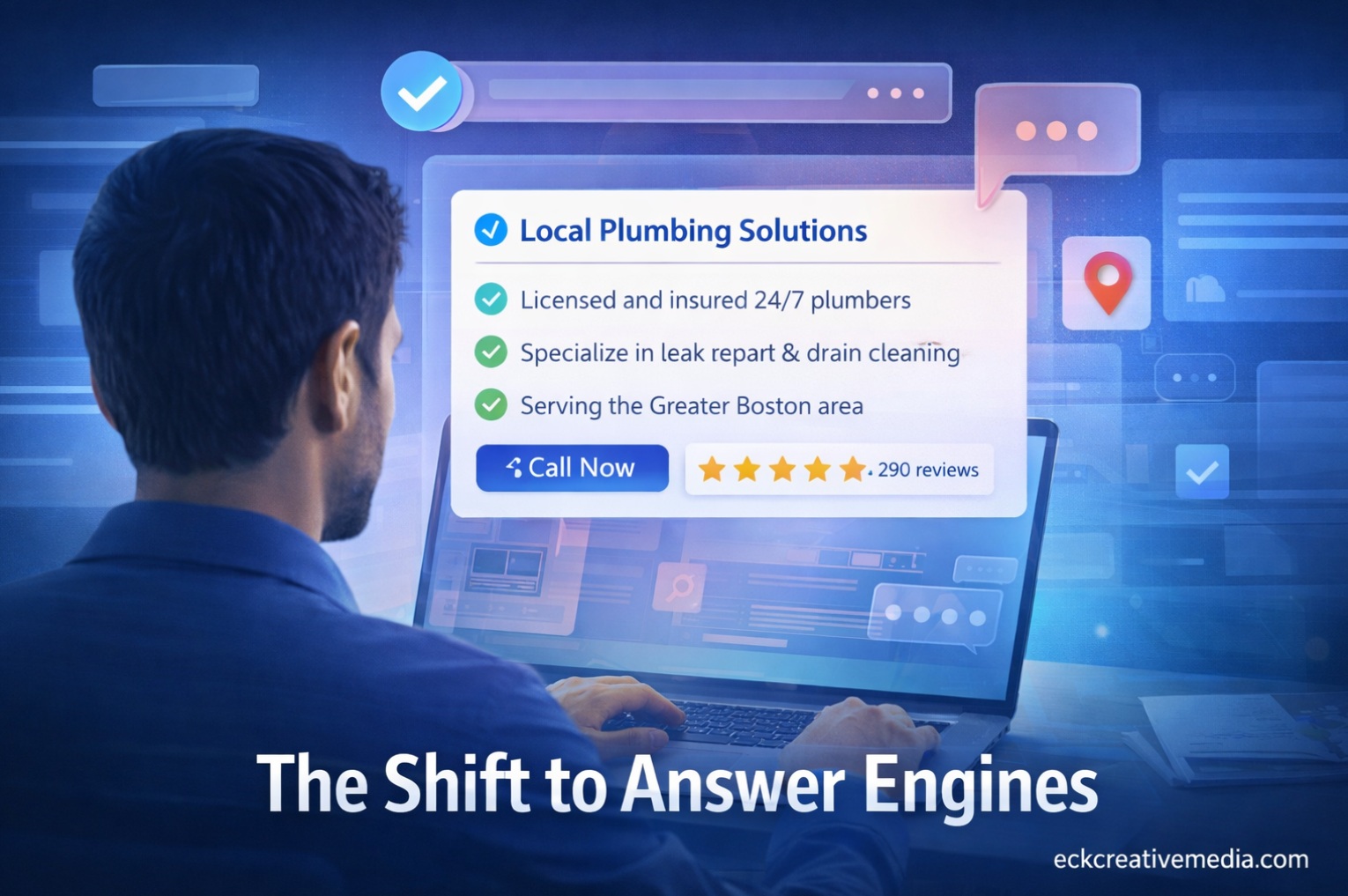
The Shift from Search Engines to Answer Engines
Search engines are no longer just lists of links.
They are becoming decision engines.
AI-driven platforms now:
-
Summarize results
-
Choose which businesses to recommend
-
Deliver answers without clicks
-
Prioritize trust, clarity, and authority over keywords alone
Ranking is no longer the final goal.
Being selected is the answer.
What Is Answer Engine Optimization (AEO)?
Answer Engine Optimization is the practice of structuring your digital presence so AI systems can understand, trust, and recommend your business.
Unlike traditional SEO, AEO focuses on:
-
Clear, direct answers to real questions
-
Structured content that machines can interpret
-
Strong service and location signals
-
Consistent authority across platforms
In simple terms:
SEO helps you show up.
AEO helps you get chosen.
When done correctly, AEO allows your business to surface in:
-
AI Overviews
-
Voice search responses
-
Featured summaries
-
Conversational AI tools
Where IP Targeting Enters the Picture
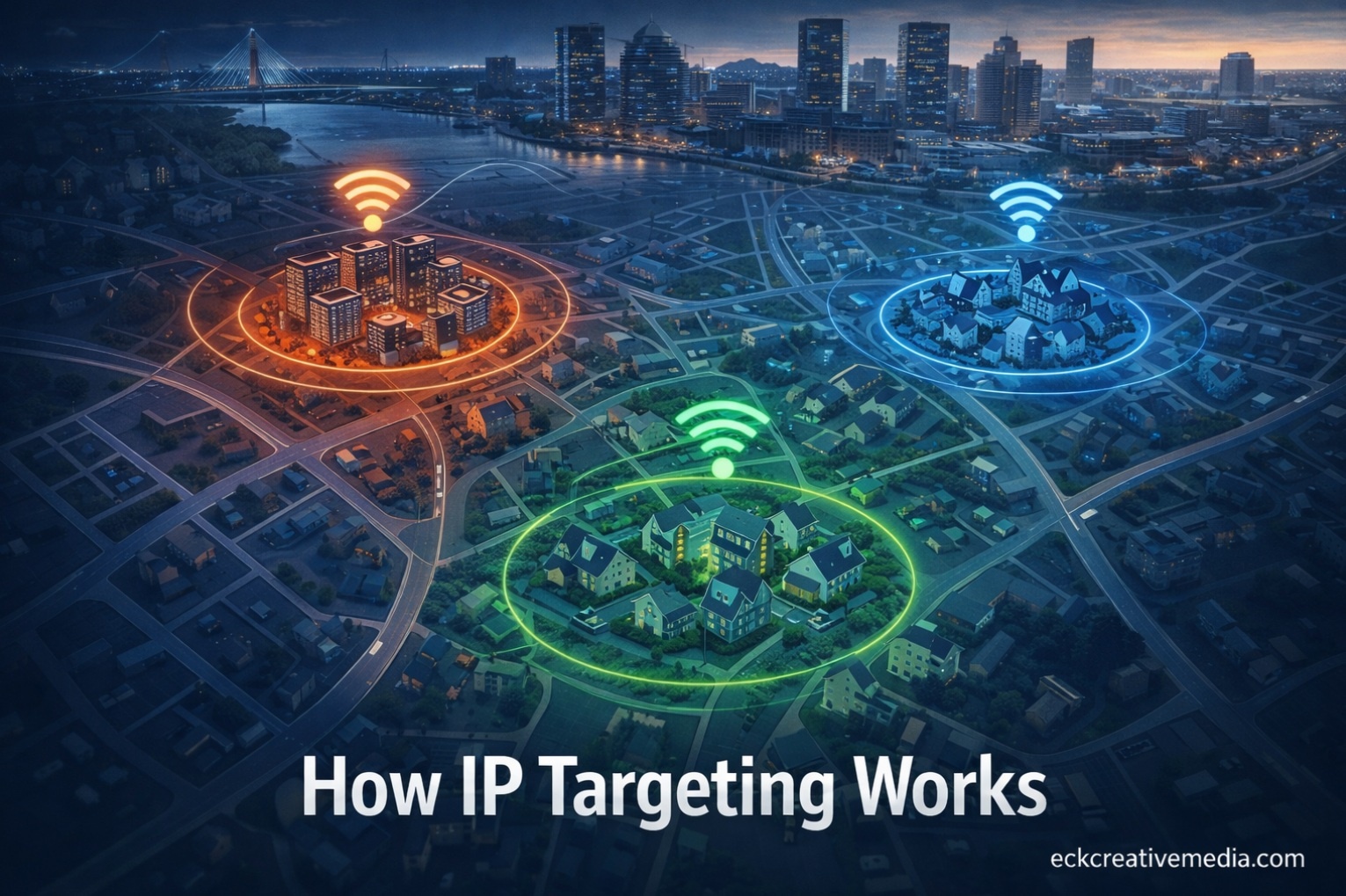
While AEO captures demand when a question is asked, IP Targeting works before the question ever exists.
IP Targeting allows businesses to deliver ads to:
-
Specific households
-
Office buildings
-
Neighborhoods
-
Campuses
-
Commercial zones
All based on real-world physical location, not cookies or browsing history.
All based on real-world physical location, not cookies or browsing history.
This means your brand can:
-
Build familiarity
-
Establish trust
-
Create recognition
-
Influence decisions early
Long before someone types
“best plumber near me”
or
“top dentist in Boston.”
The Real Power: AEO + IP Targeting Together
Separately, AEO and IP Targeting are powerful.
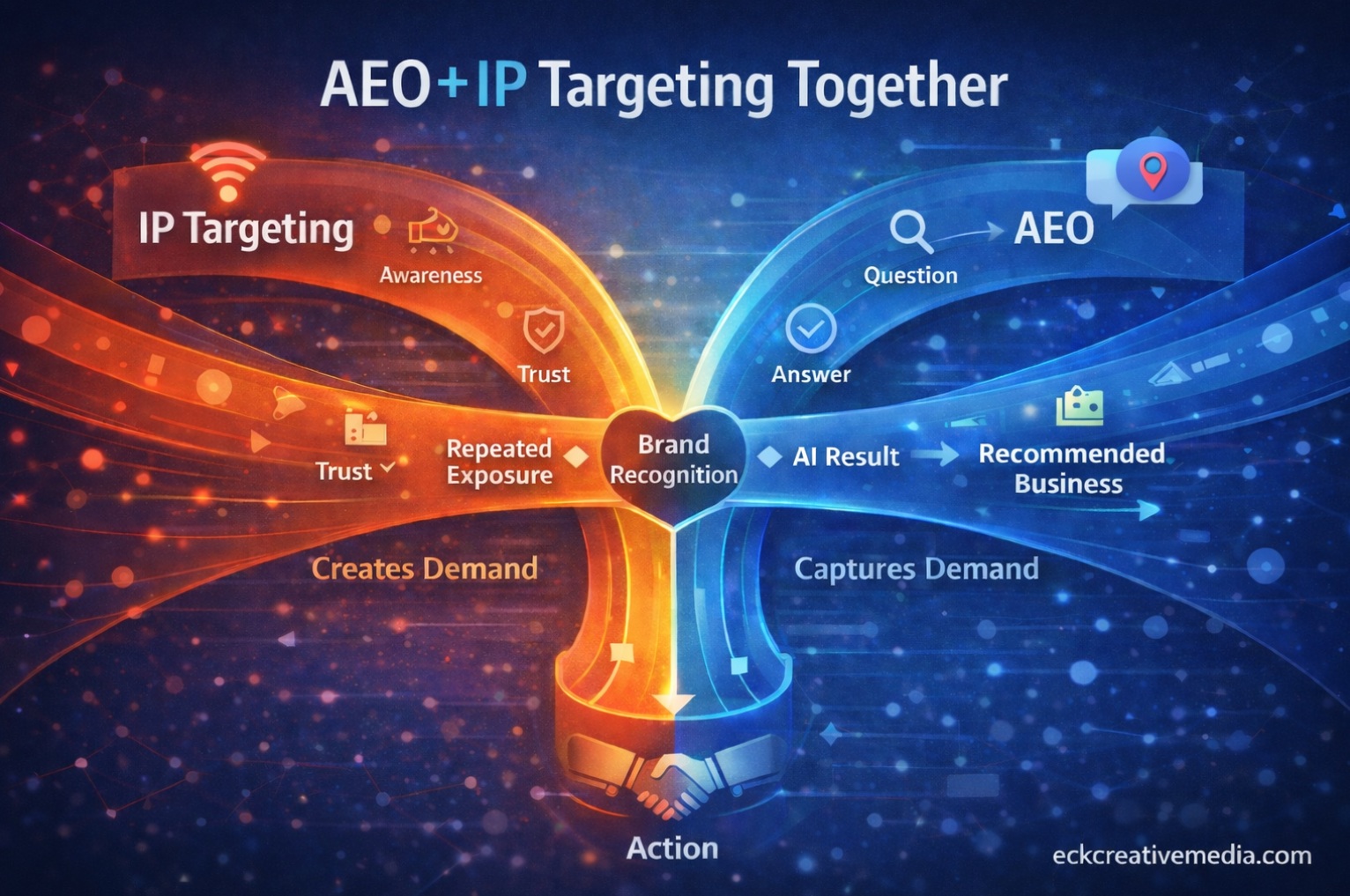
Together, they create a closed loop of influence.
Here’s how it works:
-
IP Targeting builds awareness
Repeated exposure makes your brand familiar and credible. -
Trust forms before intent
When a need arises, your name already feels known. -
AEO captures the moment of decision
When the question is finally asked, AI systems surface your business as the answer.
📌 One strategy creates demand.
📌 The other captures it.
This is post-search marketing—and it’s where competitive advantage now lives.
A Real-World Local Business Scenario
Imagine a homeowner in your service area.
-
They see IP-targeted ads for your business over several weeks
-
Your name becomes familiar
-
A problem arises—boiler, HVAC, dental pain, emergency repair
-
They ask Google or an AI assistant:
“Who’s the best local company for this?” -
AI selects your business because:
-
your content is structured and authoritative
-
your services and location are clear
-
your brand already carries trust
-
No guesswork.
No cold clicks.
Just confidence-driven decisions.
Why This Outperforms PPC Alone
Traditional pay-per-click advertising still has value — but on its own, it’s reactive.
| Traditional PPC | AEO + IP Targeting |
|---|---|
| Captures existing intent | Creates and captures intent |
| Keyword dependent | Question and trust driven |
| Click-focused | Decision-focused |
| Short-term | Compounding |
| Competitive bidding | Strategic positioning |
The future isn’t replacing PPC —
It’s elevating it with intelligence and infrastructure.
Why Eck Creative Media Is Built for This Era
At Eck Creative Media, we’ve watched digital marketing evolve for over 20 years — from early websites to SEO, from mobile-first to AI-first discovery.
Our approach is different because we don’t chase tactics.
We build:
-
Structured, answer-ready websites
-
Conversion-optimized infrastructure
-
High-precision IP targeting campaigns
-
Consistent brand authority across platforms
We don’t optimize for algorithms.
We optimize for how decisions are actually made today.
The Takeaway
If your business wants to win in the AI era, you must:
-
Be present before search
-
Be trusted during discovery
-
Be chosen at the moment of decision
That’s exactly what AEO + IP Targeting delivers.

Ready to Become the Answer?
If you want your business to appear everywhere your customers look —
Your business should be visible everywhere your customers look —
Let’s build your post-search marketing strategy.
👉 Schedule a free AEO & IP Targeting consultation with Eck Creative Media.
5 surprising facts about the post-search marketing strategy local businesses need now
- Most local purchase decisions happen after search, not during it. Consumers often use search to find options but complete purchases through messaging, maps, calls, or social proof—so the post-search marketing strategy local businesses need now focuses on rapid, personalized follow-up rather than ranking alone.
- Immediate conversational channels beat top search rankings for conversion. Data shows clicks from maps, click-to-call, and in-app messaging convert at higher rates than organic search clicks; optimizing for post-search interactions (live chat, quick replies, WhatsApp) yields faster revenue impact.
- Micro-moments create long-term loyalty when handled post-search. How a business responds to a post-search micro-moment (availability, price confirmations, appointment booking) determines repeat behavior; the post-search marketing strategy local businesses need now converts single transactions into lifetime customers by making those moments frictionless.
- Local signals beyond SEO matter more than most marketers realize. Real-time inventory, review recency, response time, and accurate business profiles in maps and directories strongly influence choices after a search; investing in these post-search signals improves discoverability and conversion together.
- Automation plus human touch drives the best post-search outcomes. Automated replies, scheduling, and follow-ups increase speed, but prospects still expect personalization; the post-search marketing strategy local businesses need now combines templates and AI with timely human escalation to maximize trust and sales.
14 Common mistakes people make about the post-search marketing strategy local businesses need now
- Treating post-search as a single tactic instead of an integrated customer journey across discovery, consideration, and purchase.
- Relying solely on SEO and ignoring on-platform experiences (maps, social profiles, voice assistants, in-app listings).
- Using generic, one-size-fits-all messaging rather than tailoring content to micro-moments and local intent.
- Neglecting real-time signals like inventory, wait times, appointment availability, and local events that affect conversion.
- Focusing only on acquisition and overlooking retention, reviews, and community advocacy that drive repeat business.
- Assuming automation replaces local knowledge — failing to combine data-driven tools with human local expertise.
- Underestimating the importance of structured local data (accurate NAP, schema, and category data) for post-search surfaces.
- Not measuring the right metrics — tracking clicks instead of conversions, calls, bookings, and foot traffic influenced by post-search interactions.
- Poor cross-channel coordination: inconsistent offers, pricing, or messaging between search, social, maps, and in-store.
- Ignoring voice and conversational interfaces when customers ask for nearby solutions hands-free or via assistants.
- Failing to optimize for mobile-first and app-first experiences where most post-search decisions happen.
- Overlooking privacy and consent requirements that affect personalization and the use of local signals.
- Not testing and iterating — treating the post-search setup as “done” instead of continuously learning from real customer paths.
- Neglecting local partnerships and community content that build trust and relevance in post-search contexts.
FAQ
How does post-search SEO fit into a local SEO strategy for small business owners?
Post-search SEO extends traditional search engine optimization by focusing on what happens after a potential customer clicks through — from landing page relevance to local listings and conversion pathways. For small businesses, combining local SEO strategies with optimized Google Business Profile listings, hyperlocal content, and clear calls-to-action improves visibility in search results and helps convert nearby customers into paying local consumers. This approach includes optimizing your google business, ensuring consistent NAP across local listings, and tailoring landing pages to the local market to boost local search ranking and ROI.
What first steps should local small businesses take to optimize their Google Business Profile and local listings?
The first steps are claiming and verifying your Google Business Profile (Google My Business profile), completing every field, adding up-to-date hours and services, uploading high-quality photos, and using relevant categories. Encourage customers to leave reviews and respond promptly to them to increase trust. Also sync information across all local listings and marketing tools so potential customers find consistent information when they search for local businesses or services in the local market.
How can content marketing and digital marketing strategies attract nearby customers after they find my listing?
Create content to local by producing hyperlocal blog posts, FAQs, service pages, and landing pages that answer common local search queries. Use content marketing to address what local customers want — price, availability, testimonials, and service area. Pair content with email marketing and social media marketing to nurture leads and encourage repeat visits. Well-crafted content plus targeted Google Ads or search ad campaigns can guide potential customers from discovery to booking or purchase, improving overall marketing efforts and generation of leads.
Are there free marketing tools or tactics that help boost post-search conversions for local businesses?
Yes. Free tactics include optimizing your Google My Business listing, using Google Search Console and Google Analytics for insights, publishing local-focused posts on your Google Business Profile, and leveraging organic social media to highlight promotions. Encourage customers to leave reviews and share user-generated content. Free tools and listings improve visibility in local search and help attract nearby customers without immediate ad spend, though paid search ads and google search ads can amplify reach when budget allows.
How do advertising and google ads fit into a post-search marketing strategy for local customers?
Advertising with google ads or local search ad formats complements organic local SEO by placing your product or service in front of nearby customers when they search. Use location targeting, call extensions, and service-area targeting for home service business or brick-and-mortar shops. Link ads to optimized landing pages that match the search intent to maximize conversions and ROI. Combine ads with local listings and email marketing to create a cohesive funnel that captures and nurtures leads.
What local marketing strategies for small businesses produce the best ROI in a post-search world?
Strategies that typically yield strong ROI include optimizing local listings and the Google Business Profile, targeted search and social ads, conversion-optimized landing pages, and review generation programs. Prioritize tracking (UTMs, call tracking, conversion pixels) to see which channels convert local consumers. Content and email marketing are crucial for retention and cross-sell opportunities, making marketing a long-term strategy that compounds returns for small businesses in 2025 and beyond.
How do recommendations, reviews, and reputation management affect local search ranking and customer decisions?
Recommendations and reviews directly impact visibility and credibility in local search results. A steady stream of positive reviews improves local search ranking signals and influences potential customers’ decisions. Encourage satisfied customers to leave a review on your google business profile and other local listings, respond to feedback professionally, and address negative reviews quickly. Reputation management should be part of your local marketing strategies to attract nearby customers and maintain conversion rates.
Which common local metrics and marketing tools should I track to measure the success of my post-search local marketing strategy?
Track metrics such as local search ranking positions, clicks and impressions from Google Business Profile, organic traffic to local landing pages, call and direction requests, conversion rate on landing pages, and ROI from google ads and social media marketing. Use tools like Google Analytics, Google Business Profile insights, Search Console, call-tracking platforms, and local marketing dashboards to aggregate data. Monitoring these metrics helps refine local seo strategies and ensures you’re effectively reaching the local audience and potential customers.
- Is AI Recommending Your Business? How to Measure AI Visibility - July 17, 2026
- The Ultimate Guide to Social Media Marketing: Success Strategies - July 9, 2026
- Landing Page Best Practices for Maximum Conversions - July 3, 2026