Skip to content
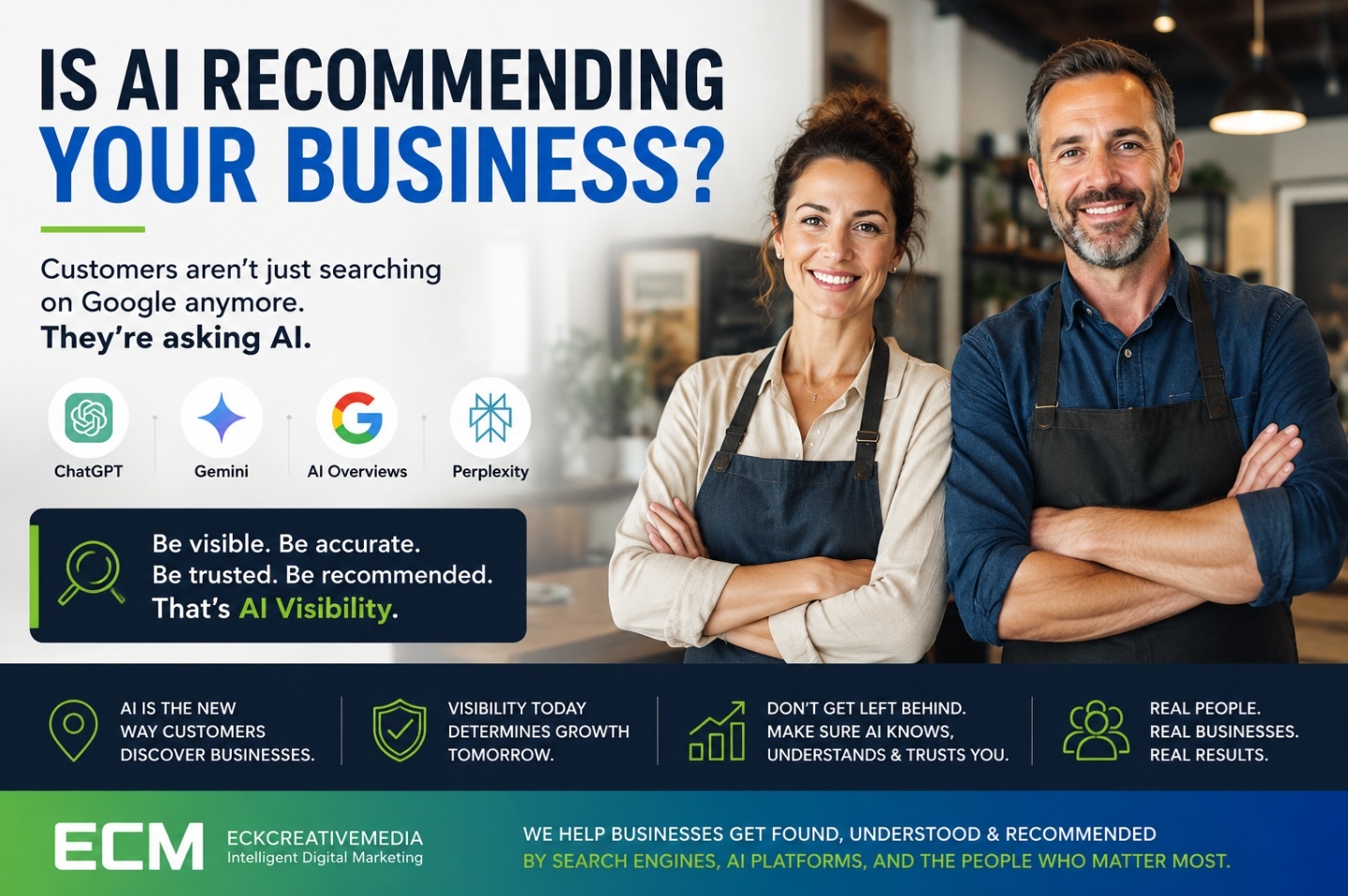
Learn how to measure your business visibility across ChatGPT, Gemini, Google AI Overviews, Perplexity, and other AI-powered search experiences.
For years, local businesses have measured online visibility by asking familiar questions:
Do we rank on Google?
Are we showing up in Google Maps?
Is our Google Business Profile performing well?
Are people finding our website through organic search?
Those questions still matter. But they no longer tell the whole story.
Today, potential customers are increasingly asking AI platforms direct questions:
“Who is the best dentist near me?”
“What are the top-rated HVAC companies in my area?”
“Which local attorney should I contact?”
“Who offers Invisalign near me?”
“What is the best company for this service?”
Instead of scrolling through ten search results, the user may receive a direct answer generated by an AI system such as ChatGPT, Google Gemini, Google AI Overviews, or Perplexity.
And that creates an entirely new question for businesses:
Is AI recommending your business?
A company can have a strong website, rank well in traditional search, and maintain an optimized Google Business Profile—and still have little or no visibility when consumers ask AI for recommendations.
That is why businesses need to begin measuring something new: AI Visibility.
At EckCreativeMedia, we believe the starting point should be an AI Visibility Baseline—a structured way to understand how AI systems currently discover, understand, describe, and recommend a business before deciding what needs to be improved.
Traditional SEO Visibility and AI Visibility Are Not the Same
Traditional local SEO has historically focused on signals such as:
- Google rankings
- Google Maps visibility
- Google Business Profile optimization
- Website authority
- Reviews
- Local citations
- Proximity to the searcher
- On-page optimization
These signals remain important.
But AI-powered discovery introduces another layer.
An AI system must be able to understand several things with confidence:
Who is your business?
Where are you located?
What services do you actually provide?
What areas do you serve?
Why should your business be considered trustworthy?
What independent sources confirm what you say about yourself?
How does your business compare with other businesses in the same market?
If the information AI systems find is incomplete, inconsistent, poorly structured, or unsupported by trusted sources, your business may not be included in an AI-generated recommendation at all.
In other cases, your business may appear—but the information may be inaccurate or incomplete.
That means simply asking, “Do we rank?” is no longer enough.
Businesses increasingly need to ask:
“Does AI understand us—and does it trust us enough to recommend us?”

The ECM AI Visibility Baseline Framework
We believe AI visibility should be evaluated across six interconnected areas:
- Visibility
The first question is the simplest:
Does your business appear when potential customers ask AI relevant questions?
This should be tested across multiple types of searches.
For example:
Discovery questions
“Best cosmetic dentist in Boston”
“Top plumber near me”
“Best family law attorney in Worcester”
Service questions
“Who offers Invisalign in Boston?”
“Where can I get treatment for TMJ?”
“Which companies install heat pumps near me?”
Trust questions
“Is [Business Name] reputable?”
“What do people say about [Business Name]?”
“Is [Business Name] a good choice?”
Comparison questions
“[Business Name] vs. [Competitor]”
“Which company is better for [service]?”
The goal is to determine how frequently the business appears across relevant AI-generated answers.
We call this your AI Visibility Rate.
If your business rarely appears, the next step is understanding why.
- Accuracy
Being mentioned by AI is not enough.
The information must also be correct.
AI systems may encounter conflicting information about a business across websites, directories, social profiles, review platforms, and other online sources.
Businesses should evaluate whether AI accurately understands:
- Business name
- Address
- Phone number
- Hours
- Services
- Service areas
- Professional credentials
- Areas of expertise
- Pricing information, when publicly available
- Important policies or differentiators
Incorrect information creates more than a poor customer experience.
It can also reduce confidence.
If multiple online sources provide conflicting information, an AI system may become less certain about which information to trust.
Consistency across the web is therefore becoming an increasingly important part of digital authority.

Why should AI trust your business?
A business website naturally describes itself in positive terms.
But AI systems can evaluate a much broader information ecosystem.
Potential authority signals may include:
- Customer reviews
- Professional credentials
- Industry associations
- Awards and recognition
- Local media coverage
- Expert articles
- Interviews
- Author biographies
- Trusted directory listings
- Community involvement
- Consistent business profiles
- References from other authoritative websites
The stronger and more consistent these signals become, the easier it may be for AI systems to understand the business as a legitimate entity within its market.
This is where traditional SEO begins to overlap with concepts such as AEO (Answer Engine Optimization), GEO (Generative Engine Optimization), and entity authority.
The objective is no longer simply to optimize a webpage.
The objective is to strengthen the entire digital identity surrounding the business.
- Citations and Sources
One of the most valuable questions businesses can ask is:
Where is AI getting its information about us?
When AI systems provide sources or citations, those sources can reveal which websites and platforms are influencing the answer.
These may include:
- The company’s own website
- Google Business Profile and Google Maps
- Professional directories
- Industry publications
- Review platforms
- News websites
- Local organizations
- Educational resources
- Trusted third-party websites
Understanding these sources creates an important opportunity.
Instead of blindly publishing more content, businesses can begin strengthening the sources that AI systems already appear to trust.
This is a fundamental shift.
Traditional SEO often asks:
“How do we rank this page?”
AI visibility adds another question:
“What information sources are shaping AI’s understanding of our business?”
- Competitive Position
AI visibility should never be measured in isolation.
If your business is not being recommended, another business probably is.
That makes competitor analysis essential.
For every important AI query, businesses should evaluate:
- Which competitors appear
- How frequently they appear
- Which businesses are mentioned first
- How competitors are described
- Which services they are associated with
- Which sources support their recommendations
- What authority signals they have that you may be missing
This creates an AI Share of Voice.
Over time, businesses can begin tracking whether their visibility is increasing or decreasing relative to competitors.
This may reveal opportunities that traditional ranking reports cannot see.
A competitor may not outrank you in traditional Google Search but may still be consistently recommended by AI.
Understanding why could become one of the most valuable forms of competitive intelligence available to a local business.
- Action Plan
An AI Visibility Audit should never end with a score.
It should answer the most important question:
What should we do next?
At ECM, we believe improvements should generally follow a logical progression.
First: Make Sure AI Can Access and Understand the Business
Review technical accessibility.
Confirm that important content can be crawled.
Validate structured data.
Check LocalBusiness, Organization, Service, FAQ, Person, and other relevant schema.
Ensure business information is accurate and consistent.
Strengthen entity relationships throughout the website.
Second: Strengthen Trust
Improve review quality and consistency.
Develop credible author and expert information.
Highlight professional credentials.
Strengthen third-party mentions.
Build authoritative citations.
Ensure the same business story is reflected consistently across the web.
Third: Build Content Depth
Once the foundation is strong, content can expand around the questions customers actually ask.
That may include:
- Detailed service pages
- Frequently asked questions
- Comparison content
- Educational resources
- Location-specific information
- Related conditions or services
- Expert explanations
- Original research or insights
The goal is not to create content simply because search engines want more pages.
The goal is to create clear, useful, authoritative information that humans and AI systems can understand and trust.
AI Visibility Is Not a One-Time Audit
AI systems are constantly changing.
Their sources change.
Their models change.
Their answers change.
Competitors improve their digital presence.
New reviews appear.
New content is published.
That means AI visibility should be measured over time.
A business might establish an initial baseline and then periodically reevaluate:
AI Visibility Rate
How often does the business appear?
AI Accuracy Score
How often is the information correct?
AI Share of Voice
How often does the business appear compared with competitors?
AI Citation Footprint
Which sources influence the answers?
AI Authority Signals
Is the business demonstrating sufficient expertise and trust?
Competitive Position
Is visibility improving or declining relative to competitors?
Tracking these signals over time can help businesses determine whether their AI optimization efforts are actually working.
The Future of Local Search Is Bigger Than Google Rankings
Google Search is not disappearing.
Neither is SEO.
But the way consumers discover businesses is expanding.
A customer may find a business through Google Maps.
Another may ask ChatGPT.
Another may receive an answer from Google AI Overviews.
Another may research options using Gemini or Perplexity.
The businesses that succeed in this new environment will need to be visible across this entire discovery ecosystem.
That requires a broader strategy.
SEO helps search engines find you.
AEO helps answer engines understand your information.
GEO helps generative AI systems recognize and potentially reference your expertise.
Entity authority helps establish who you are and why you should be trusted.
Together, these disciplines are becoming part of a larger objective:
Making your business understandable, credible, and discoverable wherever customers search—or ask.

The Question Every Business Should Be Asking
Most businesses know approximately where they rank on Google.
Far fewer know what AI says about them.
They don’t know whether ChatGPT recommends them.
They don’t know whether Gemini understands their services.
They don’t know which competitors appear instead.
They don’t know whether AI is presenting accurate information about their business.
And they don’t know which sources are shaping those answers.
That is why the first step in AI visibility is not simply creating more content.
The first step is establishing a baseline.
Find out what AI knows about your business.
Find out what it gets wrong.
Find out who it recommends instead.
Find out which sources it trusts.
Then build a strategy based on evidence rather than assumptions.
Because in the emerging world of AI-powered discovery, the most important ranking may eventually be one you cannot see in a traditional ranking report.
It is whether AI knows enough about your business—and trusts it enough—to recommend you.
Is Your Business Visible in AI Search?
EckCreativeMedia helps businesses strengthen their visibility across traditional search and the rapidly evolving world of AI-powered discovery.
Our approach brings together SEO, Answer Engine Optimization (AEO), Generative Engine Optimization (GEO), structured data, content authority, entity optimization, and AI visibility intelligence to help businesses build a stronger and more consistent digital presence.
The goal is simple:
Make sure your business can be found, understood, and trusted—by search engines, AI systems, and the customers using them.
Frequently Asked Questions About AI Visibility
What is AI visibility?
AI visibility is how often and how accurately your business appears in answers and recommendations generated by AI-powered search platforms. It can include whether your business is mentioned, how it is described, where it appears compared with competitors, and which sources support the recommendation.
How do I know if AI is recommending my business?
Test relevant customer questions across AI-powered search experiences and record whether your business appears in the answers. Examples include “best [service] in [city],” “who offers [service] near me?” and “[your business] vs. [competitor].” Results can vary by platform, location, query, and time, so testing should be repeated periodically.
Can my business rank well on Google but still be invisible in AI search?
Yes. Strong traditional search rankings do not guarantee that an AI system will mention or recommend your business. AI-powered discovery can rely on a broader combination of signals, including website content, business data, reviews, structured data, third-party sources, and overall digital authority.
What factors can influence whether AI recommends a business?
Potential factors include accurate business information, authoritative website content, customer reviews, structured data, professional credentials, trusted third-party mentions, consistent business profiles, and other signals that help AI systems understand and verify the business.
What is an AI Visibility Audit?
An AI Visibility Audit evaluates how a business appears across AI-powered search and answer platforms. It can measure visibility, factual accuracy, competitive position, citations, trusted sources, and potential authority gaps to establish a baseline for future improvement.
What is the difference between SEO, AEO, GEO, and LLM optimization?
SEO focuses on improving visibility in traditional search engines. AEO, or Answer Engine Optimization, helps make information clear, structured, and useful for systems that provide direct answers. GEO, or Generative Engine Optimization, focuses on strengthening content and authority signals that may help generative AI systems understand, reference, or recommend a business. LLM optimization is a broader, informal term for improving how easily large language model-powered systems can understand, verify, and potentially surface information about a business. In practice, these strategies often overlap through structured data, entity optimization, authoritative content, consistent business information, and trusted third-party signals.
Does schema markup help with AI visibility?
Structured data, commonly called schema markup, helps machines understand important information about a business, its services, people, locations, and content. Schema alone does not guarantee AI visibility or recommendations, but it can contribute to a clearer and more structured digital identity.
How can a local business improve its AI visibility?
Start by ensuring that the business can be accurately understood across the web. Maintain consistent business information, strengthen service and location content, implement appropriate structured data, build credible reviews and third-party authority, and monitor how the business appears in AI-generated answers.
How often should AI visibility be measured?
AI visibility should be monitored periodically because AI platforms, models, sources, and answers can change over time. Establishing a baseline and repeating the same core queries on a consistent schedule makes it easier to identify changes in visibility, accuracy, and competitive position.
Why does AI visibility matter for local businesses?
AI-powered search is becoming another way consumers research businesses, compare options, and make purchasing decisions. If an AI system does not understand or recognize a business, potential customers using these tools may discover a competitor instead.

- Is AI Recommending Your Business? How to Measure AI Visibility - July 17, 2026
- The Ultimate Guide to Social Media Marketing: Success Strategies - July 9, 2026
- Landing Page Best Practices for Maximum Conversions - July 3, 2026