 Skip to content
n a world awash with data, how do you ensure your organization isn’t just collecting information but transforming it into actionable insights? The answer lies in a well-structured Knowledge Catalog. This capability is not merely about storing data; it’s about organizing knowledge in a manner that empowers executives to make informed decisions swiftly and confidently. As business leaders, you face the challenge of navigating through an overwhelming amount of information. The Knowledge Catalog serves as your roadmap, turning chaotic data into strategic insights that drive your organization forward.
The Business Problem that Knowledge Catalog Solves
Organizations today are often inundated with vast amounts of data, leading to a phenomenon known as data overload. This influx can create decision paralysis, where executives struggle to extract actionable insights from the noise. Imagine a marketing team overwhelmed by data from multiple sources, struggling to determine which insights are actionable for their upcoming campaign. A well-structured Knowledge Catalog would streamline their access to relevant information, enabling them to make informed decisions quickly.
Understanding Data Overload
When faced with data overload, decision-makers may feel overwhelmed and unable to sift through the noise. A Knowledge Catalog provides clarity and structure, allowing organizations to navigate through this chaos effectively. It organizes insights in a way that not only makes them accessible but also relevant to the specific challenges at hand. Without a Knowledge Catalog, organizations risk missing out on valuable insights that could significantly impact their strategic direction.
Executive Questions Addressed by Knowledge Catalog
As a leader, you need answers to critical questions that impact your organization’s strategy. A Knowledge Catalog helps address these queries, providing a framework for informed decision-making. Here are some vital questions that executives often grapple with:
Key Questions for Leaders
- What insights are most relevant to our current business challenges?

- How can we leverage our existing knowledge to drive growth?

- Which data sources should we prioritize for actionable intelligence?

- How can we ensure that our decision-making processes are not hindered by data overload?

- What metrics should we focus on to measure our strategic success?
By answering these questions, the Knowledge Catalog empowers executives to focus on what matters most for their business growth. It creates a structured approach to decision-making, allowing leaders to access the information they need when they need it.
What Knowledge Catalog Is (and Is Not)
To leverage the full potential of a Knowledge Catalog, it’s essential to understand its definition and scope. It is a structured repository of insights and data designed to facilitate decision-making. However, it is not merely a content library or a data dump; the focus is on the strategic organization and accessibility of knowledge.
Defining Knowledge Catalog
A Knowledge Catalog organizes information in a coherent manner, transforming raw data into meaningful insights that executives can act upon. It aligns with the organization’s objectives and enhances the clarity of information flow. This structured approach not only aids in decision-making but also fosters a culture of knowledge sharing within the organization.
Common Misconceptions
Many leaders misconstrue a Knowledge Catalog as just another database. In reality, it serves a distinct purpose: to provide a strategic framework that supports informed decision-making rather than just storing data. It’s not about having more data; it’s about having the right data organized in a way that facilitates effective decision-making.
How Knowledge Catalog Turns Data into Decisions
The transformation of data into actionable insights is at the core of what a Knowledge Catalog achieves. By organizing information effectively, it enables executives to access relevant insights quickly, enhancing their ability to respond to market changes. This capability is especially crucial in fast-paced industries where timely decisions can make or break a business.
The Executive Intelligence Cycle
This framework guides decision-making by ensuring that the right data is available at the right time. The Executive Intelligence Cycle emphasizes the importance of structured knowledge management in facilitating effective decision-making processes. It involves a continuous loop of collecting, analyzing, and applying insights to drive strategic initiatives.
How Knowledge Catalog Fits into the Broader EMCC System
Within the Executive Marketing Command Center (EMCC), the Knowledge Catalog plays a crucial role. It enhances the overall effectiveness of EMCC by supporting other capabilities like the Executive Dashboard and AI Visibility. This integration ensures a cohesive approach to executive decision-making.
A Component of Executive Marketing Command Center
The Knowledge Catalog not only supports EMCC but amplifies its capabilities. By providing structured knowledge, it enables seamless access to insights that drive strategic decisions, reinforcing the organization’s authority in its market. The synergy between the Knowledge Catalog and other EMCC components ensures that executives have a comprehensive view of their operational landscape.
Business Outcomes from Implementing Knowledge Catalog
Implementing a Knowledge Catalog leads to tangible benefits for organizations, including improved clarity in decision-making processes and enhanced ability to leverage insights for strategic growth. The outcomes are not just theoretical; they translate into real-world results that can significantly impact your organization’s trajectory.
Expected Results
- Improved clarity in decision-making processes.

- Enhanced ability to leverage insights for strategic growth.

- Increased executive authority and trust in data-driven decisions.

- Reduction in decision-making time due to streamlined access to information.

- Greater alignment of organizational strategies with actionable insights.
These outcomes empower executives to act with confidence, knowing they have access to the insights needed to navigate their organizations effectively. By fostering a data-driven culture, organizations can achieve sustainable growth and competitive advantage.
Frequently Asked Questions
Knowledge Catalog Questions Executives Ask
What is a Knowledge Catalog?
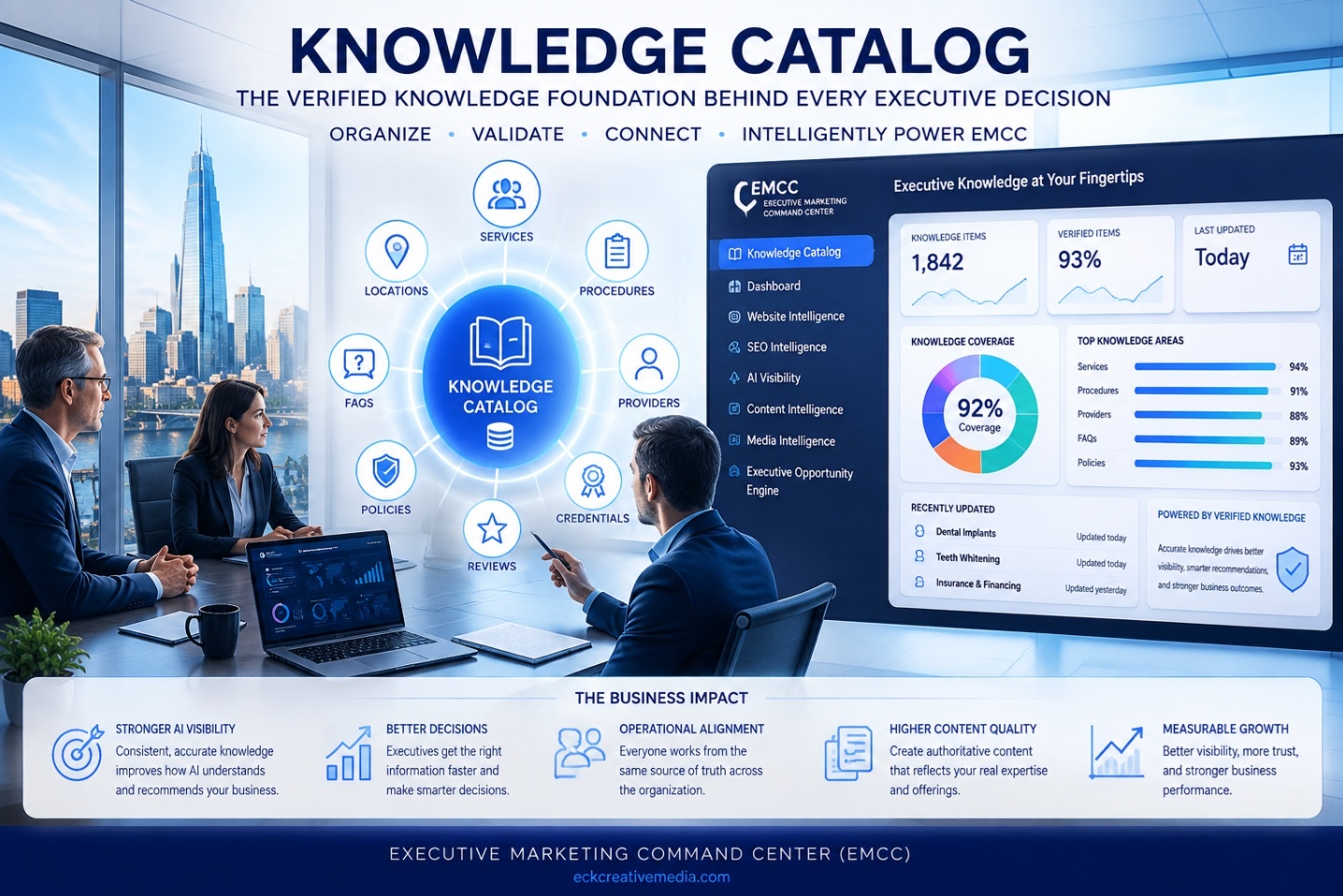
A Knowledge Catalog is the verified organizational knowledge repository within Executive Marketing Command Center (EMCC). It organizes services, products, procedures, locations, policies, FAQs, credentials, and other institutional knowledge into a trusted source that supports executive decision-making, AI visibility, content creation, and marketing intelligence.
How does a Knowledge Catalog improve executive decision-making?
Instead of searching through websites, documents, spreadsheets, or employee knowledge, executives gain immediate access to verified business information. This improves decision speed, increases confidence, reduces inconsistencies, and ensures strategic recommendations are based on trusted organizational knowledge.
What information can be stored in a Knowledge Catalog?
A Knowledge Catalog can include services, products, procedures, provider profiles, locations, frequently asked questions, pricing guidance, policies, credentials, reviews, contact information, and other verified business knowledge. Every organization builds a catalog that reflects its expertise and business objectives.
How is a Knowledge Catalog different from a traditional database?
A traditional database simply stores information. A Knowledge Catalog transforms verified information into structured organizational knowledge that supports executive intelligence, AI understanding, content creation, and strategic business decisions.
How does the Knowledge Catalog improve AI visibility?
AI platforms perform best when they access consistent, accurate, and well-structured information. A Knowledge Catalog strengthens AI visibility by creating a reliable source of truth that improves content quality, topical authority, and how AI systems understand your business.
How does the Knowledge Catalog support other EMCC intelligence modules?
The Knowledge Catalog serves as the knowledge foundation for Executive Marketing Command Center. It continuously supports Website Intelligence, SEO Intelligence, AI Visibility Intelligence, Content Intelligence, Media Intelligence, Google Ads Intelligence, and the Executive Opportunity Engine by providing verified organizational information.
Can the Knowledge Catalog integrate with our existing systems?
Yes. The Knowledge Catalog is designed to complement your existing website, CRM, content management system, analytics platforms, marketing tools, and business applications. It centralizes verified knowledge while supporting information across the entire marketing ecosystem.
How often should a Knowledge Catalog be updated?
A Knowledge Catalog should evolve continuously as your business grows. Whenever services, products, procedures, locations, personnel, policies, or marketing content change, the catalog should be updated to ensure executives, customers, and AI systems always reference accurate information.
What business benefits can organizations expect?
Organizations benefit from faster executive decisions, improved AI visibility, stronger topical authority, more consistent content, better collaboration, higher content quality, and more reliable recommendations generated from verified organizational knowledge.
Who should manage the Knowledge Catalog?
The Knowledge Catalog should be maintained collaboratively by marketing leaders, subject matter experts, and business stakeholders. Executive Marketing Command Center (EMCC) helps organize, validate, and leverage this institutional knowledge so every intelligence module works from the same trusted foundation.