Skip to content

In the last few years, student interest in the stock market has surged.
Students aged 18–35 are learning about trading through TikTok, Discord, Reddit, and YouTube — places full of passion but low on real guidance. Many dive in without structure, without risk management, and without the essential rules that protect traders from destructive mistakes.
They want to trade.
They want to learn.
But they’re entering the market through the wrong door.
This is exactly where IP targeting can help — and where disciplined trading frameworks like the Trend Template can guide a student from excitement to longevity.

1. The New Wave of Student Traders
More students than ever are asking questions like
- “How do I start trading?”
- “What’s the best strategy?”
- “How do people make money in the market?”
- “Should I trade options?”
The curiosity is real.
The hunger is real.
But the guidance is missing.
Instead, students are often hit with:
- Influencers selling dreams
- Options sellers promising weekly income
- “Zero risk” strategies that don’t actually exist
- Opinions disguised as expertise
- Emotional, hype-driven trading
This environment is not just confusing — it’s dangerous.
Students need a safe path.
Students require a path that is both safe and disciplined.
Students require a path that is based on rules and regulations.

2. The Core Problem: Opinion-Based Learning
Trading without a framework is like flying without instruments.
Most students learn through:
- FOMO
- Revenge trades
- Overconfidence
- Selling options before understanding risk
- Social media signals
- Friend recommendations
- Emotional decisions
This leads to the same painful cycle:
-
A few wins
-
Confidence builds
-
Risk increases
-
A single loss wipes out gains
-
They think “trading doesn’t work”
-
They quit — or worse, they double down
This is how great potential gets lost.
3. Why Students Need Structure Early
A disciplined framework like the Trend Template — 10 over 20, price over 50 — gives students the FIRST real taste of what trading truly is:
- Structure
- Rules
- Clarity
- No opinions
- No emotions
- No predictions
It instills in them the fundamental principle of trading: never lose more than you can earn.
For a student trader, this lesson can be life-changing.

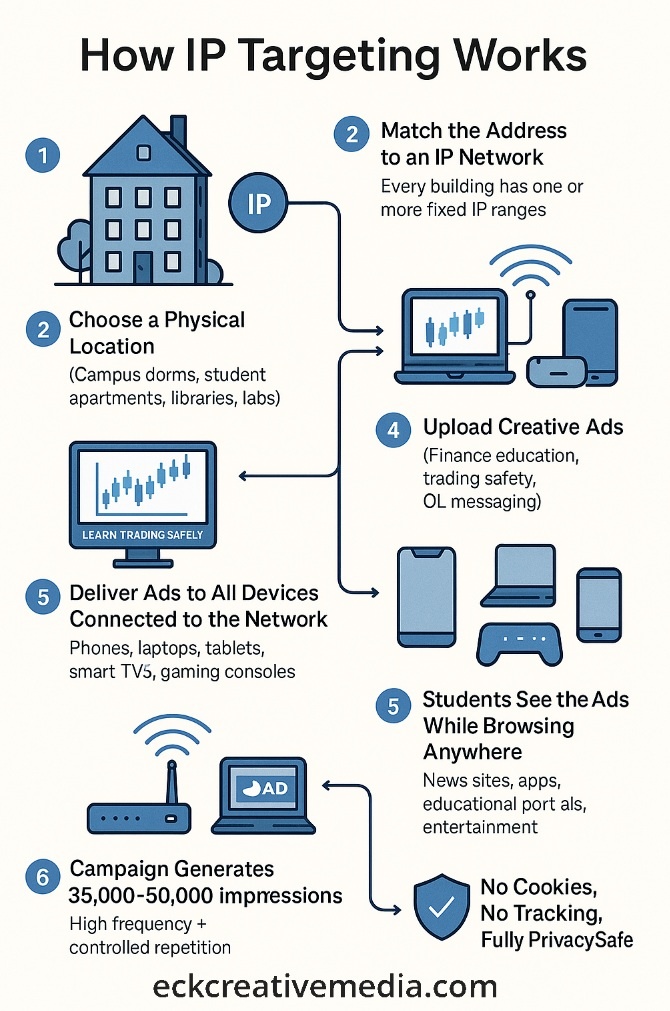
4. What Is IP Targeting?
It doesn’t use personal data.
It doesn’t track individuals.
It simply matches an IP network to a physical location.
Perfect For College Environments
IP targeting can reach students in:
- Dorms
- Campus apartments
- Libraries
- Study areas
- Lecture halls
- Student centers
- Labs
- Greek housing
- Off-campus complexes near campus
Every phone, laptop, tablet, or gaming console connected to those networks becomes part of the ad reach.
This is ethical, clean advertising.
No manipulation.
No tracking.
Just presence.
5. Why IP Targeting Works Better Than Social Media Ads for Students
Social media ads rely on algorithms, interest guesses, and swipe behavior. Most ads get ignored instantly.
IP targeting solves all of that:
- No cookies needed
- No interest targeting needed
- No wasted impressions
- No scrolling required
- No competition with noise and entertainment
It delivers the message where students live, learn, focus, and think.
This is why IP targeting campaigns see:
- Higher match quality
- Greater brand trust
- Better retention
- More visibility
- More meaningful clicks
It’s one of the only ways to reach students quietly, consistently, and respectfully.
6. Typical IP Campaign Performance
A student-focused IP targeting campaign typically produces:
📌 35,000 to 50,000 impressions per month (per campus cluster)
These impressions reach:
- Laptops
- Tablets
- Phones
- Smart TVs
- Gaming consoles
- Shared campus devices
This creates controlled repetition, which builds:
- Familiarity
- Recognition
- Trust
- Curiosity
This is precisely the environment where a disciplined trading framework stands out from the hype.
7. Guiding Students Toward Safe Trading Practices
This is where communities like OL shine.
With structured education built on:
- OVTLYR Trend Template (10/20/50 discipline)
- Controled-Risk trading
- Price-based decisions
- Avoiding option selling
- Long-term consistency over short-term dopamine
Students can finally learn that trading is not a casino, not a shortcut, and not social entertainment — it is a skill that requires structure.
IP targeting allows this message to reach students before they fall into the trap of:
- Overtrading
- Excessive risk-taking
- Opinion-driven trades
- Following influencers
- Emotional decision-making
It gives them a safer on-ramp.
8. Why Trusted Trading Communities Are Essential
Students want mentorship.
They want belonging.
They want accountability.
They want a roadmap.
A community built on price, discipline, and clarity can change the way a young trader sees the market — and themselves.
Low-cost memberships with Ovtlyr (like $300/year) make this accessible, ethical, and perfectly aligned with student budgets.
9. Why Now Is the Perfect Time to Act
Student interest in trading is exploding.
Financial awareness is at an all-time high.
The misinformation ecosystem is larger than ever.
IP targeting gives us the chance to step in before mistakes happen, not after.
It is the right strategy, at the right moment, for the right audience.

10. Conclusion: Building a Smarter Generation of Traders
Students don’t need opinions.
They don’t need hype.
They don’t need shortcuts.
They need structure.
They need rules.
They need protection.
They need a community built on truth.
IP targeting is the bridge that connects them to that guidance, at exactly the moment they need it most.
If we reach them early, we can help build a generation of traders who are:
- disciplined
- risk-aware
- long-term focused
- trend-driven
- free from hype
It’s not just advertising.
It’s education.
It’s prevention.
It’s empowerment.
And it’s the future.
5 Surprising Facts About Trading
These surprising facts highlight why understanding market dynamics and tools like how IP targeting helps student traders enter the market safely and smartly can make a real difference.
- Emotions often drive short-term market moves more than fundamentals — behavioral biases like herding and loss aversion can create predictable patterns for disciplined traders.
- Most retail traders lose money initially; however, structured learning, risk management, and targeted access tools can dramatically improve outcomes for students.
- Liquidity varies by time and asset — markets can be deep during certain hours and thin at others, causing larger-than-expected price swings for small orders.
- Technology and order execution speed matter: small latency improvements and smart routing can shave costs and reduce slippage, especially for strategies that rely on quick reactions.
- Data and targeted access (for example, methods akin to how IP targeting helps student traders enter the market safely and smartly) let novice traders access tailored educational offers, simulated environments, and region-specific liquidity, reducing exposure while they learn.
10 Common Mistakes People Make About Trading
Many new traders—especially students—fall into predictable traps. Understanding these mistakes and how tools like IP targeting can help is essential for anyone who wants to enter the market safely and smartly.
1. Treating trading like gambling
Viewing trades as bets rather than decisions based on analysis, risk management, and planning leads to impulsive behavior and large losses.
2. Ignoring risk management
No stop-loss, oversized positions, or failing to calculate position size are common errors. Risk management protects capital and longevity in the market.
3. Overleveraging
Leverage amplifies both gains and losses. Many traders use too much leverage without understanding worst-case scenarios.
4. Chasing tips and hot picks
Following unverified tips or social media hype instead of a tested strategy often results in buying at peaks and selling in panic.
5. Neglecting education and strategy testing
Jumping into live trading without backtesting, paper trading, or learning basic technical and fundamental concepts is a frequent mistake.
6. Emotional trading
Fear and greed drive many poor decisions. Sticking to predefined rules and automating parts of the plan can reduce emotional interference.
7. Overtrading
Trading too frequently to feel productive increases transaction costs and exposure to noise rather than real opportunities.
8. Neglecting fees, slippage, and tax implications
Failing to account for commissions, spreads, slippage, and tax consequences can erode returns significantly.
9. Poor record-keeping
Without a trading journal that tracks rationale, outcomes, and metrics, traders cannot learn systematically from mistakes or refine strategies.
10. Unrealistic expectations
Expecting quick riches or consistent high returns leads to disappointment and risk-taking that can wipe out accounts.
FAQ
1. What makes IP targeting more accurate than social media ads?
Social media ads rely on interest tags and behavior predictions. IP targeting uses verified physical locations — like dorms, libraries, and student housing — ensuring your message reaches real students connected to those networks. There is no guessing. It delivers with precision.
2. Does IP targeting avoid wasted impressions?
Yes. Social media platforms show ads to broad audiences who may or may not be students. With IP targeting, every impression is delivered to devices connected to student residential or campus networks, eliminating waste.
3. Is IP targeting more privacy-safe than social media?
Absolutely. IP targeting does not use cookies, personal information, or behavioral tracking. It matches ads to locations, not individuals — making it inherently safer, cleaner, and fully privacy compliant.
4. Why do students respond better to IP-targeted ads?
Because these ads appear in environments where students are focused, studying, researching, and learning, not mindlessly scrolling. This context makes them more receptive to educational, trading, or financial content.
5. Does IP targeting bypass algorithm limitations?
Yes. Social media algorithms decide who sees what. Your ad may be buried behind trends, memes, or entertainment content. IP targeting bypasses algorithm interference entirely, giving guaranteed placement across all devices in a chosen location.
6. Can IP targeting reach students who use ad blockers or avoid social media?
Yes. Since IP targeting uses the campus network itself, it reaches all connected devices — even students who use minimal social media or avoid ads on specific platforms.
7. Are IP-targeted impressions more consistent?
Very. Instead of depending on unpredictable social media scrolling patterns, IP targeting creates steady, repeated exposure throughout the day across laptops, tablets, and phones. Consistency = higher recall.
8. Why is IP targeting more cost-effective for student outreach?
Because every impression is delivered to a real student environment. Social media CPMs can be inflated due to irrelevant impressions. IP targeting often produces higher match rates and lower cost per qualified student.
9. Do IP-targeted ads blend better with student life?
Yes. IP-targeted ads appear on news sites, educational portals, apps, and devices students use academically and socially — creating a natural, campus-integrated presence instead of interruptive social feed placement.
10. Which method is better for promoting disciplined trading education to students?
IP targeting. It reaches students in calm, focused environments where they are more likely to absorb important financial messages — especially those related to risk management, trading discipline, and avoiding hype — rather than competing with social media noise.
- Is AI Recommending Your Business? How to Measure AI Visibility - July 17, 2026
- The Ultimate Guide to Social Media Marketing: Success Strategies - July 9, 2026
- Landing Page Best Practices for Maximum Conversions - July 3, 2026